My dustbin tally spreadsheet has a whole tab now just for arguing with manufacturer spec sheets. Every time I write up a bot, someone in the comments asks me to just line up the raw numbers -- suction, bin size, battery -- next to the other ones I've actually run in this house. So this is that page. I started keeping it the same month I logged the Roomba i3 that tapped out on our basement stairs, and I add a row whenever a new bot comes through or a brand quietly changes a number on its own site without telling anyone.
The DEEBOT on this list is the same family as the one that spent an entire cleaning run getting eaten by the fringe on our living-room rug. Sam walked in, watched it grind sideways under the ottoman for a solid minute, and said, "Is it supposed to sound like that?" It was not. That's a whole separate post. This one is just the numbers, and only the numbers I could actually confirm on a live source -- if a brand's own page didn't say it, it's not in here as if the brand said it.
Technical Definitions
- Suction (Pa)
- Measured in Pascals (Pa), this is the pressure difference the motor can generate. Higher isn't automatically "cleans your floor better" -- brush design and airflow matter just as much, and I've had a lower-Pa bot outperform a higher-Pa one on the runner rug more than once.
- Bin Size (ml)
- The internal dust container, in milliliters. For bots with an auto-empty station, this is the small onboard chamber the robot fills between runs -- not the bigger bag or bin sitting in the dock, which holds weeks of dirt, not one session's worth.
- Battery Capacity (mAh)
- Milliampere-hours -- the battery's total charge. It's a rough proxy for runtime, but manufacturers measure "runtime" on whatever setting makes the number biggest, which is almost never the setting you actually clean on.
Specifications Comparison Table
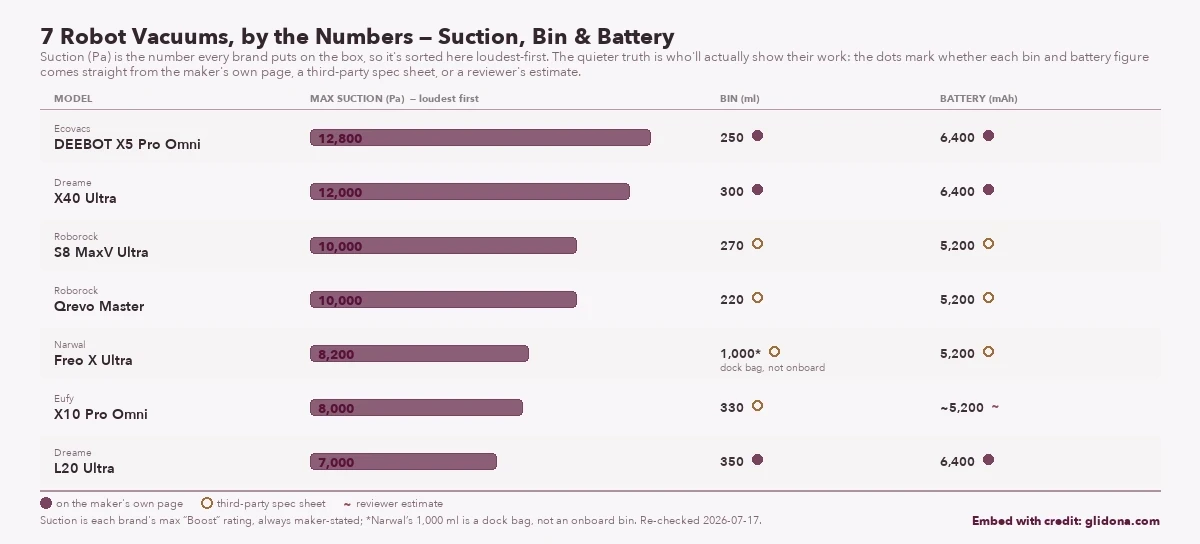
These are the manufacturer-reported numbers for the flagship and mid-range models I get asked about most, pulled from each brand's own product page wherever they'd actually publish it. Suction figures are each brand's max "Boost" or "Max+" rating, not what you'd run day to day.
| Model | Max Suction (Pa) | Internal Bin (ml) | Battery (mAh) |
|---|---|---|---|
| Ecovacs DEEBOT X5 Pro Omni | 12,800 [1] | 250 [1] | 6,400 [1] |
| Dreame X40 Ultra | 12,000 [2] | 300 [2] | 6,400 [2] |
| Roborock S8 MaxV Ultra | 10,000 [3] | 270 [4] | 5,200 [4] |
| Roborock Qrevo Master | 10,000 [5] | 220 [6] | 5,200 [6] |
| Narwal Freo X Ultra | 8,200 [7] | 1,000 (HEPA dust bag)* [8] | 5,200 [9] |
| Eufy X10 Pro Omni | 8,000 [10] | 330 [11] | ~5,200 [11] |
| Dreame L20 Ultra | 7,000 [12] | 350 [12] | 6,400 [12] |
*Correction, because I got this wrong the first time I built this table: that 1,000 ml figure is Narwal's disposable HEPA dust bag capacity, and it lives in the base station, not inside the robot -- it's what lets the whole system go up to seven weeks between empties, per Narwal's own numbers. Narwal doesn't publish how big the robot's own tiny onboard chamber is, the way the other rows in this column mean it, so treat this row as "biggest thing between you and a full dock," not an apples-to-apples onboard-bin number.
Measurement Variances and Standards
Pascals are the number every brand puts on the box, but they're measured at the motor or intake port under sealed lab conditions -- not with a brush head three inches off your actual hardwood. I don't have a way to independently verify Pa in my kitchen, so take the suction column as "what the manufacturer says," full stop.
Battery runtime is the other one to watch. The 5,200 mAh Roborocks are both rated for about 180 minutes on their lowest cleaning mode -- and that's the one number I had to go dig up off a third-party spec aggregator, because neither Roborock retail page actually lists bin size or battery capacity anywhere I could find. Ecovacs and both Dreames put every one of these numbers right on their own product page. Roborock buries the same information somewhere I couldn't locate on their own site. That was the real trade-off that came out of building this table: the flagship with the single biggest suction number wasn't the flagship most willing to show its work.
And that's before you get to the apps. Every one of these companion apps wants an account before it'll even tell you the battery is charging -- Roborock's made me re-verify my email mid-setup, ECOVACS wanted location permissions to pair over Bluetooth. None of that is in the spec sheet. It should be.
Certain brands, like iRobot, don't publish a Pascal number at all -- they use their own "Air Power" or "Suction Power" scale instead, which isn't directly convertible to Pa. I've left iRobot models out of this table rather than guess at a conversion.
Last verified: 2026-07-17
Sources
- [1] Ecovacs Official: DEEBOT X5 PRO OMNI Specifications
- [2] Dreame Technology: X40 Ultra Technical Data
- [3] Roborock US: S8 MaxV Ultra Product Page
- [4] SmartRobotReviews: Roborock S8 MaxV Ultra Specs Chart
- [5] Roborock US: Qrevo Master Product Page
- [6] SmartRobotReviews: Roborock Qrevo Master Specs Chart
- [7] Narwal Robotics: Freo X Ultra Product Page
- [8] Narwal Robotics: Self-Empty vs Self-Contained Dust Collection
- [9] BIKMAN TECH: NARWAL Freo X Ultra Spec Breakdown
- [10] eufy US: X10 Pro Omni Product Page
- [11] Robot-Review.com: eufy X10 Pro Omni Review
- [12] Dreame Technology: L20 Ultra Specifications