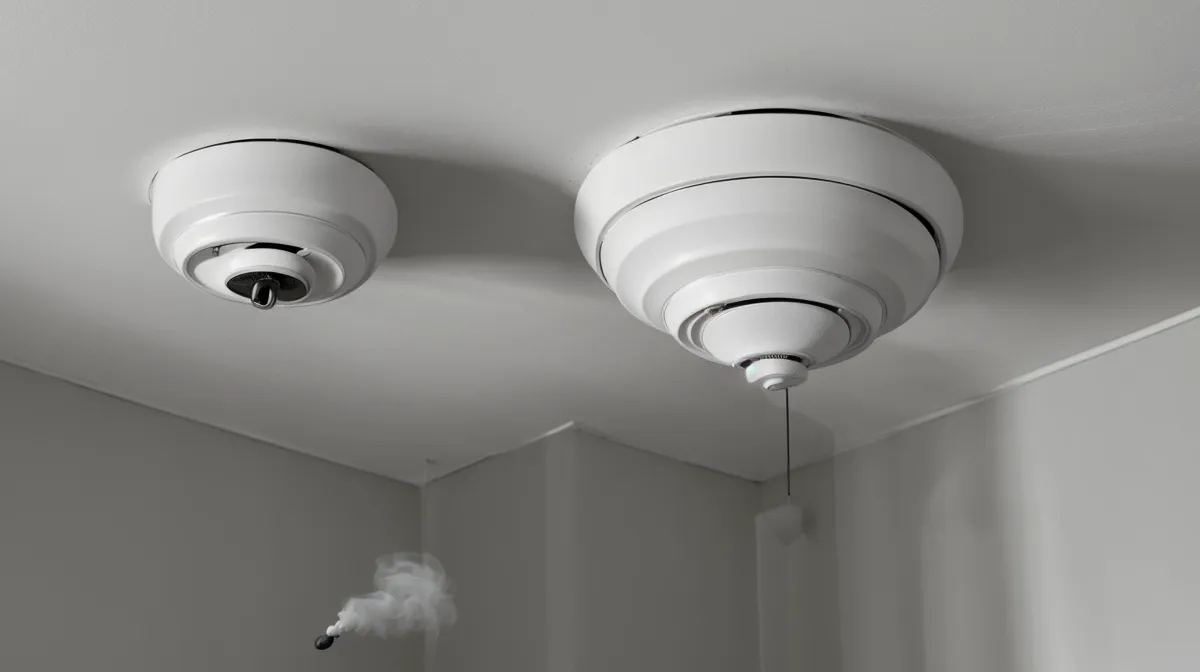
Four seconds. That's roughly the lead time the X-Sense app gives my phone before the in-house horn even starts warming up, and it's the number this whole smoke-detector review keeps circling back to.
A quick disclosure before the comparison starts: the smart-home-safety gear linked through this piece, X-Sense included, pays me a commission if you buy through it, at no extra cost to you. I've tested every unit named here myself, usually with a husky mix trying to eat the packaging, and none of these picks are theoretical — they're what survived two shedding rescue dogs and one very old bungalow.
The Landlord's Pucks vs. the X-Sense Hub
Our craftsman bungalow came with the landlord's original detectors: yellowed plastic pucks that had clearly outlived their welcome. The National Fire Protection Association recommends swapping any smoke alarm out after a decade, sensors included, and ours were closer to fifteen years old — no app, no data, just a shriek if you happened to be home when it went off.
Comparing that old system against the X-Sense Smart Smoke and CO Detector is really a comparison of two philosophies: dumb-but-guaranteed versus smart-but-dependent. A standard sealed alarm never needs an app, never needs Wi-Fi, and never has a bad night with your router. It just screams. X-Sense trades that simplicity for real notification design, the same instinct that has me weighing the LG CordZero Robot's auto-empty dock against its rivals for the dustbin tally I've kept since March 2024. If a robot vacuum can text me that its bin is full, a smoke detector should be able to text me before it decides to wake the whole house.
Fifteen Minutes of Hardware, Twenty of Wi-Fi Grief
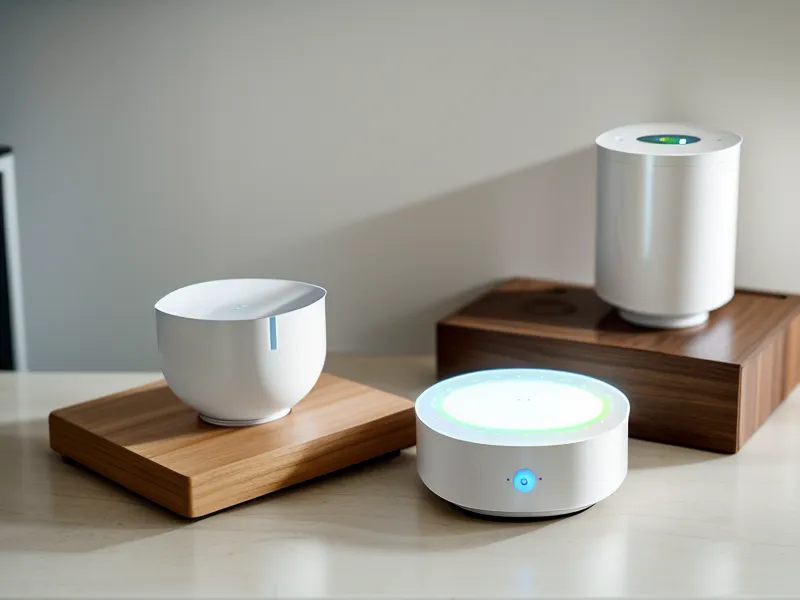
Mounting the hardware was the fast part. Three ceiling brackets went in under fifteen minutes total, each one locking into the old plaster with a solid click that made the landlord's flimsy plastic tabs look worse by comparison. The software is where the friction actually lives. X-Sense routes every detector through a central hub, and that hub flatly refused to acknowledge my 5GHz-only guest network for a solid twenty minutes before I figured out the problem.
Most of these hub-and-spoke systems need a 2.4GHz band specifically because the lower frequency punches through old plaster and lath, where 5GHz gives up a room or two in. Once I forced my phone onto the legacy network, pairing finished in under a minute — the exact gap between hardware reliability and software reliability that shows up constantly in this line of testing. For anyone dealing with a similar floor plan, I leaned on Where to Install X-Sense Smart Detectors in an Older Two-Story Home to figure out where the hub needed to sit so it could actually reach every bedroom.
App-UX complaints are basically a house tradition at this point, and this one earned its spot. Onboarding walks you through more confirmation screens than a checkout flow needs, then buries the actual sensor status two menus deep. I sent a screen recording to Colette Morrow, a UX colleague I've traded app-onboarding complaints with for years, and her read was blunt: too much hand-holding for a tool whose entire job is telling you your house might be on fire.
Does the App Alert Actually Beat the Horn?
The real test wasn't staged. I scorched a piece of sourdough badly enough to trip real smoke while unloading the iRobot Roomba j7+ bin — the same run its camera nosed around a stray treat Murph had abandoned near the baseboard, the sort of object-avoidance that keeps that bot from grinding through anything Beans leaves behind outside. My phone buzzed with a smoke alert before the horn even cleared its throat. There was time to grab a towel, wave it under the sensor, and tap Silence in the app before Sam looked up from the other room. Beans stayed asleep. Murph tilted his head at the noise and went back to guarding the abandoned treat.
That gap between the phone buzz and the actual siren is the entire case for X-Sense, and it holds up under normal household chaos. Heavy Wi-Fi traffic — video calls, big file uploads — slows the app notification by a second or two at most, and the horn still hasn't caught up by the time the alert lands. A dumb detector can't offer that grace period. It goes straight to sound, which is the right call in a real fire and a genuinely rough one for burnt toast.
Not every gadget in this house earns that kind of trust. A cut-rate robot vacuum I grabbed on a whim, well under what any of the tested brands charge, met its match in the fringe on our IKEA rug and never recovered. Third run in, it stalled in the exact same corner, wheels spinning against the same tangle of thread, and I finally flipped it over to cut the mess free, the plastic underneath still warm enough to smell like a motor that had just been working. That bot never left the closet again. It's a reminder that "smart" doesn't mean much if the hardware gives up before the software gets a chance to help.
The Comparison Table: Safety Gear vs. Cleaning Gear
Comparing a smoke detector to a robot vacuum sounds like a stretch until the actual complaints line up against each other. The Roborock S8 Pro Ultra earns its keep on mapping speed — it locks in a floor plan in about half the runs the Roomba needs — but its app is dense enough that a first-time owner needs a weekend to learn it, roughly the same hub-and-app tax X-Sense charges at setup. Reliability and simplicity keep trading places depending on which box is being tested.
The PuroAir HEPA 14 Air Purifier sits closer to what X-Sense is actually trying to do. It ramps its fan the moment it senses a change in particulate, roughly the same instinct that has the smoke detector firing a push notification before the horn catches up, and its true HEPA-grade filter is a genuine rarity at its price bracket without needing me to say the number out loud. I wrote up the dust-filtration side of that unit separately in PuroAir HEPA 14 Review for Managing Dust in a Craftsman Bungalow, but the short version for this comparison: its sleep mode reads a genuinely quiet 28 dB on the meter, while the X-Sense horn is engineered to do the opposite, because that's the one moment you actually want the whole house to hear it.
| Feature | X-Sense Smart Detector | LG CordZero Robot | PuroAir HEPA 14 |
|---|---|---|---|
| Primary Job | Life Safety / App Alerts | High-Pile Rug Cleaning | Dander Filtration |
| App UX | Simple but Hub-Dependent | Very Clean Onboarding | Basic (Timer only) |
| Pet Factor | Prevents Siren Meltdowns | Husky Hair Tangles | HEPA 14 Grade |
| Maintenance | 10-year sensor life | Weekly brushroll check | 6-month filter swap |
Choosing Between the Old Alarm and the Smart One
So which one actually deserves a spot on the ceiling? A standard sealed ten-year alarm still makes sense if zero maintenance matters more than a few extra seconds of warning: no hub, no Wi-Fi band to fight, no app to open in the middle of the night. Choose the X-Sense system instead if burnt toast or bacon grease sets off false alarms in your kitchen on a regular basis, or if sensitive dogs make those first few seconds of siren the actual crisis rather than the smoke itself — the phone alert buys the exact window Beans and Murph need to stay calm instead of bolting for the basement door.
The hub requirement is a real cost, and losing Wi-Fi drops the system back to a loud, dumb alarm with none of the smart features, though it still works as a legitimate alarm on its own. For a house that already tracks robot-vacuum runs for fun, the trade felt obvious. Anyone weighing the same decision, the X-Sense Smart Smoke and CO Detector is the one worth pointing at first — just have the 2.4GHz password ready before climbing the ladder.