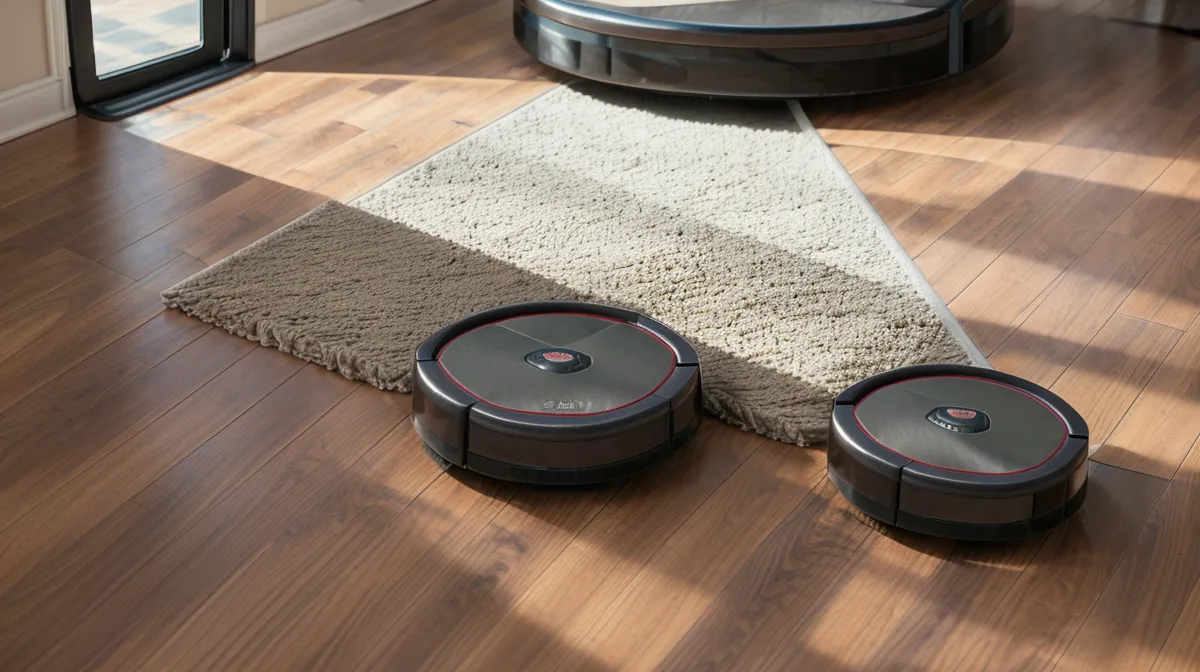
My hand shoots out before I even register what's happening: the robot vacuum's front wheel already tipped over the edge of the basement stairs, the door standing wide open behind it because someone left it that way again hauling laundry down. It's not the first time a bot has gotten close to that stairwell. The original Roomba i3 didn't get caught in time, and the sound of it tumbling down those steps in early 2024 is still the reason the dustbin tally started in the first place: weighing Murph's and Beans's fur on a kitchen scale after every run, logging every robot vacuum that's come through this house since.
For a while after that, the plan was a stopgap: park the handheld Dyson at the top of the stairs and do manual spot runs myself instead of trusting a bot anywhere near the edge. That lasted about as long as most good intentions in this house — the handheld sat there gathering its own dust until Sam finally hauled it back to the closet, because nobody actually reaches for a second vacuum when the first one is supposed to be running the whole route on its own. As a UX writer who spends the rest of my week trying to make software invisible, I think about a smart-home purchase like this the same way: the real test isn't the spec sheet, it's whether the thing survives contact with your actual house.
This checklist is what that tally has turned into — not a features list you could copy off any electronics site, but the five questions I actually ask now before letting a new bot anywhere near this floor plan. None of them show up on the box. All five have already cost somebody in this house a return, a Friday night, or a bot.
How Much Doorway Clearance Does a Robot Vacuum Actually Need?
By the fourth week of running the tally, I'd already ruled out two flagship-tier bots for the same reason: neither one could climb the oak transition strips between our dining room and kitchen. Newer houses tend to have flat floors. A 1920s craftsman does not — every doorway here is a half-inch lip of solid wood, and a bot with impressive specs on paper still stops, backs up, tries again, and eventually gives itself a stuck alert instead of just rolling over the thing.
The math is simple enough: an inch is 25.4 millimeters, and most high-end bots advertise a clearance right around 20mm, comfortably under half an inch — on a lab floor. My doorways are not a lab floor. If your own transition strips run anywhere near that spec limit, budget for the bot spending real battery life head-butting the board before it admits defeat. I measure every new doorway with a tape measure before a test unit even comes out of the box now, which sounds excessive until you've watched a five-hundred-dollar machine lose a fight with a piece of trim.
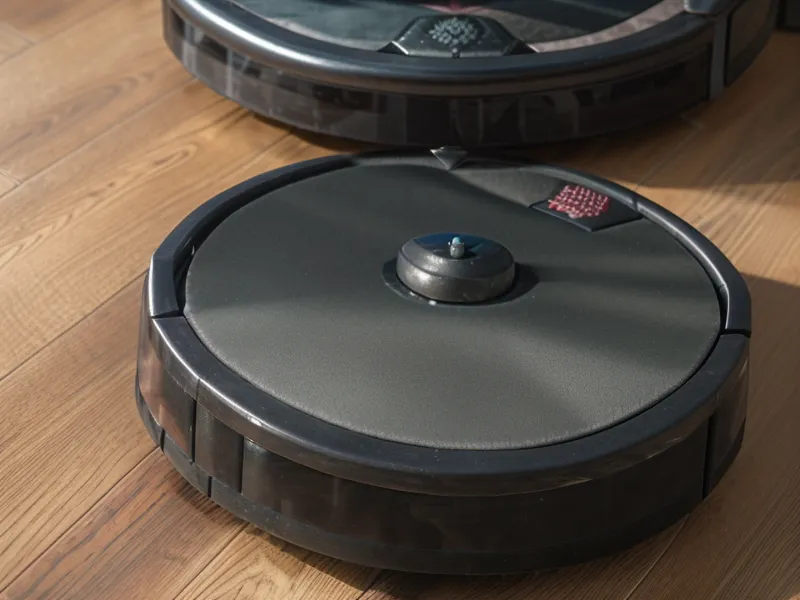
Clearance problems are mechanical, not sensor problems, and that distinction matters more than the marketing suggests. No amount of camera-based obstacle avoidance or LiDAR mapping helps a wheel that physically cannot climb a strip of oak. It just means the bot gives up more elegantly, with a nicer app notification about it.
The Noise Test Nobody Puts on the Spec Sheet
Suction numbers on a spec sheet don't tell you anything about how a bot actually sounds inside a room you're trying to work in. I hold my phone up with a decibel meter app running more often than I'd like to admit, and the tone matters more than the raw number — a high, whiny pitch on bare hardwood carries through the whole downstairs in a way a duller hum on the hallway runner never does.
My neighbor Reginald noticed me doing this from the front hall one afternoon and brought it up over the back fence a few days later — said the whine reminded him of a blower motor about to fail, which, coming from a retired HVAC guy, felt like an actual diagnosis instead of a guess. 'That's not going to end well,' he said, and he wasn't wrong — the unit's motor got worse over the following weeks, not better.
Sam has a lower tolerance for it than I do. 'Can we just go back to pushing the regular vacuum,' he asked, more than once, after that same bot's pitch climbed every time it crossed from the hallway onto the rug — not because Beans startles easily, but because the sound made the whole downstairs feel like something was about to break. If you're testing units yourself, listen for a change in pitch between surfaces, not just a change in volume. That's the part a spec sheet will never capture.
Check the App Before You Check the Suction
Every robot vacuum app treats onboarding like a sales funnel, and I say that as someone who designs onboarding flows for a living. One unit demanded four separate firmware updates before it would even show a live map of the house — the whole process felt like walking in for a single lipstick and getting routed through a rewards signup, a credit card pitch, and a skin-type quiz before anyone would ring you up.
'You've uninstalled this app how many times now,' Sam asked, watching me delete a companion app for the second time in one evening because it wouldn't let me set a no-go zone around Beans's water bowl without sitting through a tutorial video first. Check the app store reviews before you check anything else. Does it force a login every session. Does it lose the map the moment the Wi-Fi blips. Those answers matter more than another point of suction.
The app-versus-hardware tension gets its own full log in my tracking notes from eight weeks with the LG CordZero, where genuinely good hardware kept getting undercut by software that acted like it didn't trust the person who paid for it. A bot with mediocre suction and a clean app actually gets used. A bot with great suction and an app you dread opening spends most of its life sitting in the dock.
Fur Management Is a Design Problem, Not a Spec
Murph and Beans shed enough that brush roll design matters more than almost anything else on this list. Bristled rollers wind fur into a solid, felted core that needs actual scissors to cut free, and I've spent more Friday nights than I want to admit crouched on the kitchen floor doing exactly that. Rubberized rollers push the hair toward the ends instead, where it comes off in one pull — that difference alone has kept two bots in permanent rotation and sent two others straight to the donate pile.
How much bin a single run actually fills is worth knowing too. I've watched the kitchen scale's readout flicker between two numbers as a full bin settles onto the plate, which is as close as this operation gets to a real lab, though bin capacity on its own is a deeper question than this checklist has room for. Filtration is worth a glance in the same breath, though what actually counts as true HEPA versus marketing filler is its own long conversation I've had in more detail elsewhere. None of this touches thick, wall-to-wall carpet either — a heavy-shedding house without hardwood underneath is close to a different appliance category, and it deserves its own checklist rather than a footnote in this one.
Most of what actually challenges a bot's fur handling in this house starts outside anyway. Mud and grit Murph drags in after his loop around the Broad Ripple Park dog trail get worked into the hallway runner before any vacuum touches them, and that combination shows up clearly in the pet hair spreadsheet as the gap between a bot's lab rating and what it actually picks up in a real, dirty house.
Where Does the Bot Actually Get Stuck?
Five questions can't cover everything, and I'd rather say that outright than pretend this list is exhaustive. Mapping speed and mapping accuracy don't always move together — a bot that maps your house fast is not necessarily the one that maps it correctly, and the difference only shows up after a few weeks of real runs. Suction and battery life trade against each other in ways no spec sheet states plainly, and the mop-versus-vacuum decision is really a question about how much extra maintenance you're willing to take on for a wet-clean pass you may only need occasionally.
Whether a bot can avoid what a dog leaves behind in the yard is a real concern in some houses and irrelevant in others, and it deserves a full answer of its own rather than a line here. Clearing a low sectional sofa without stalling is the same story — some bots simply can't, no matter what their profile measurement claims on the box. None of this even gets into air purifier placement or where a smart smoke and CO detector actually belongs in an older two-story house, both of which are entirely different shopping problems from the one this checklist solves. The noise floor question has a deeper answer too, and I cover most of it in my PuroAir HEPA 14 review instead of repeating it here.
A reader named Fabiola emailed after one of my long-term reviews ran, asking whether the replacement she was eyeing — after a return loop on a Black Friday deal that hadn't worked out — would actually hold up better in her house, which is close to wall-to-wall carpet throughout, nothing like this hardwood bungalow. That email is the reason I now flag, in almost everything I write since, that a checklist built for hardwood doesn't automatically apply to an all-carpet house.
So here's the one thing worth carrying out of all five questions: a high price tag buys better marketing language, not a machine that automatically understands your doorways, your noise tolerance, or your particular dog. Test the boring stuff first — the threshold, the pitch change between surfaces, the app, the roller — before a feature list talks you into five hundred dollars you can't easily send back.