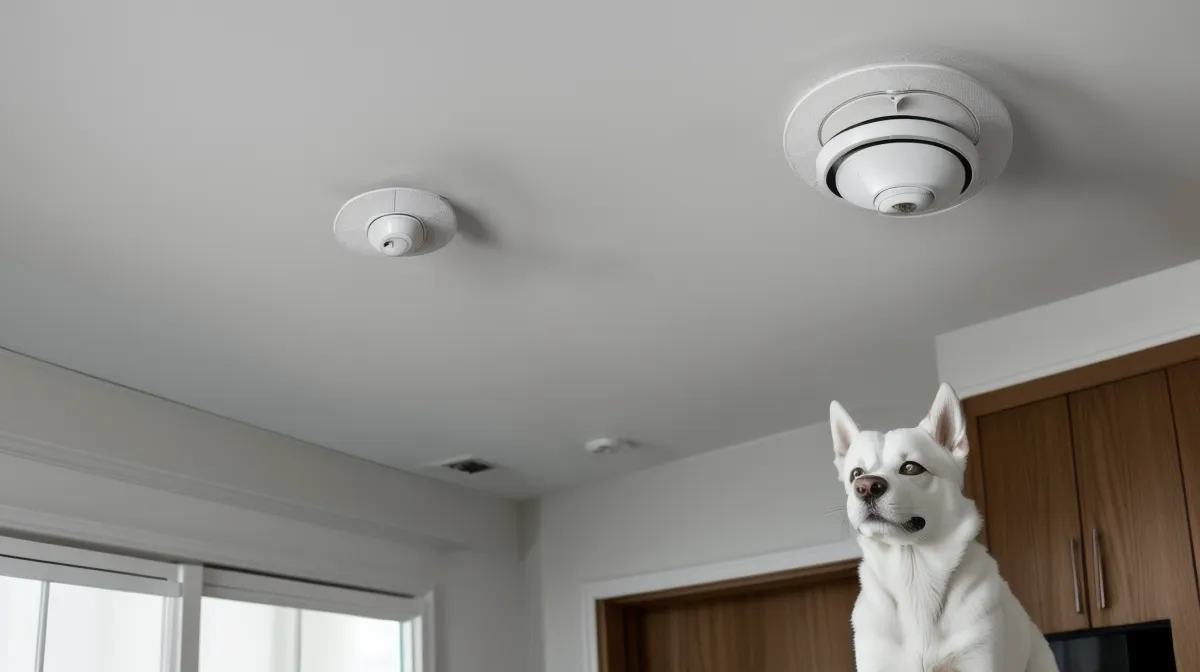
A screaming ten-year battery and a four-second phone notification are not the same kind of home safety warning, and testing both in the same house is what finally convinced me a smart smoke detector earns its keep over the dumb kind hanging in most rental hallways. One woke the entire house, dogs included, at full volume for no reason anyone could see. The other let me silence a false alarm from my back pocket before either dog even lifted its head.
Quick disclosure before the questions start: the smart-home links in this piece are commission links — including the ones that route you to X-Sense directly, or to an Roomba j7+ — and I get a small cut if you buy through them, at no cost to you. The dustbin tally that anchors most of what I write comes from actual kitchen-scale weighings in my own hallway and basement, and the notes below come from three smoke-detector units mounted in this house, not a review sample a brand mailed me for a week. If that ever changes, I'll say so up top.
The Screaming Battery That Started This Test
Murph reacted first. A husky mix doesn't wait for a piercing electronic tone before deciding something is wrong — he's got a specific, low 'woof' reserved for anything he considers a real threat, and a sealed-battery alarm losing its charge in the hallway apparently qualified. That old unit didn't chirp politely. It screamed at full volume while Beans hid under the console table and Sam stood in the hallway with a broom handle, trying to reach the reset button. After years of logging how the LG CordZero handles dog hair for the dustbin tally, I'd never once pointed the same scrutiny at the safety hardware bolted to my own ceiling. If a robot vacuum can learn to route around a dog toy, the smoke detector could stand to be smarter about how it talks to the humans in the house.
Does Pairing Really Take Fifteen Minutes?
The hardware side, yes. I ordered the X-Sense Smart Smoke and CO Detector the week after the screaming-battery incident, picked the version that comes with a dedicated hub, and swapped three ceiling units in about the time it takes to run a full cycle on a Roborock S8 Pro Ultra. Pulling the old units and mounting the new ones is a genuine fifteen-minute job per room, twist-lock base and all. The hub is supposed to be the part that squeezes a full decade out of one sealed battery, since it talks to each detector over its own radio link instead of making every unit hold a constant WiFi connection — I won't pretend to understand the engineering past that, but it's the reason the box says ten years and not two.
App onboarding is the part that isn't fifteen minutes. Screen after screen. Half of them asking you to reconfirm something you already confirmed two taps earlier. I sent a screenshot of the third 'Connection Failed' screen to Colette, a UX-writer friend up in Columbus I still swap app-onboarding horror stories with, and her whole response was a single question mark.
Why the Hub Kept Failing to Connect
My phone failed to find the hub three times before I figured out why. My router runs a mesh network that steers every device toward whichever band looks faster, and it had parked my phone firmly on 5GHz. This hub pairs over 2.4 GHz only, so as far as the app was concerned, my phone wasn't even in the room. I spent twenty minutes in the router's admin panel splitting the two bands into separate network names while Sam held a ladder in the hallway and asked, more than once, whether this was actually going to be worth it. It was — but only once I forced the phone onto the slower band before opening the app at all, which is the one tip I'd hand anyone setting this up: check your band first, not after.
It reminded me of a fix that didn't work months earlier, when I dragged my vacuum's charging dock into the hallway convinced a more central spot would close a coverage gap on the far side of the house. It blocked foot traffic for a week and the coverage gap stayed exactly where it was. Moving a base station doesn't fix a signal problem if the signal problem was never about distance in the first place, and that's exactly what the mesh-router band issue turned out to be too.
Is the Pre-Alarm Actually Faster Than the Horn?
Yes, and by enough of a margin that it's the single feature I'd pay for again. I was elbow-deep in sourdough one afternoon while the PuroAir HEPA 14 Air Purifier ran in the next room, got pulled away by a work message, and came back to the smell of scorched crust. My phone buzzed with a pre-alarm notice before the in-house horn even started ramping up — roughly four seconds of warning, going by the app's own notification timestamp against the horn kicking in — which was enough time to hit silence, pull the bread, and turn the PuroAir up before either dog registered anything was wrong. A plain photoelectric sensor would have just gone straight to the horn. That gap between 'something's off' and 'the horn is screaming' is the entire pitch for the smart version, and it held up the one time I actually needed it.
I still remember Sam crouching by the sectional after a vacuum run, pointing at a strip of dust the bot never touched, not saying a word. That's the bar I hold every device to now: not the marketing copy, but whether it does the one specific job in the one specific corner where it matters. The X-Sense cleared that bar in the kitchen. It hasn't been tested by an actual fire, and I hope it never is.

How It Fits Into a Bigger Home Automation Setup
This house already runs on a small fleet of connected devices, so a smart detector wasn't really a leap. The LG CordZero Robot handles the daily husky tumbleweeds, and the PuroAir keeps beagle dander down in the bedroom — though where exactly you put an air purifier in a room is its own question I've already answered in a separate post. None of that is directly comparable to a smoke detector, to be clear. Dustbin capacity and how fast a bot maps a new floor plan are separate rabbit holes covered elsewhere, and whether you should weigh suction against battery life on the LG is a completely different decision from anything a fire-safety device deals with. The mop-versus-vacuum trade-off that comes up when people compare hybrid bots doesn't apply here either — the X-Sense just listens for smoke and carbon monoxide and otherwise stays out of the way. Even the Roomba's actual pet-waste avoidance, which I've written up with the specific moment it proved itself, and the finer points of HEPA filtration grades on the PuroAir belong to their own reviews, not this one. What ties them together for me is the app layer: if you're piecing together a pet-heavy household setup, the safety hardware deserves the same scrutiny as the vacuum bots. The Roomba j7+ earns trust by avoiding what the dogs leave behind in the yard, and the X-Sense earns the same kind of trust by texting me about a dying battery instead of screaming about it in the middle of the night.
Where the Hub Actually Needs to Sit
Reliability comes down to placement, same as it does for a robot that has to find its way back to a dock. The hub needs a central spot in the house, not tucked behind a metal filing cabinet or shut inside a closet, or offline alerts start showing up that have nothing to do with an actual problem. It's a similar lesson to the one I took from running the Roomba j7+ and Roborock through a basement stairs test — hardware fails quietly when you put it somewhere convenient instead of somewhere it can actually do its job. Exactly where to mount each detector in an older two-story layout, stairwells included, is enough of its own topic that I've given it a separate write-up rather than cramming a floor-by-floor breakdown in here.
X-Sense Smart Smoke Detector vs. the Rest of the Fleet
On maintenance, the sealed ten-year battery is about as close as fire safety gets to a maintenance-free promise — the kind of low-effort ownership the LG CordZero's auto-empty dock is aiming for on the vacuum side, minus the part where you still have to empty a bag every so often. On app UX, the X-Sense clears a low bar: it beats the ECOVACS app, which is not a high compliment, and it's functional once you're past setup, but the onboarding flow is exactly where most people are going to want to throw their phone across the room.
If you're tired of a dying alarm announcing itself at full volume in the middle of the night, and you're trying to protect a set of dog ears along with everyone else's, the X-Sense Smart Smoke and CO Detector is worth the setup headache. Just get your router's band situation sorted before you open the app, and don't expect the onboarding to respect your time the way the hardware respects your walls.