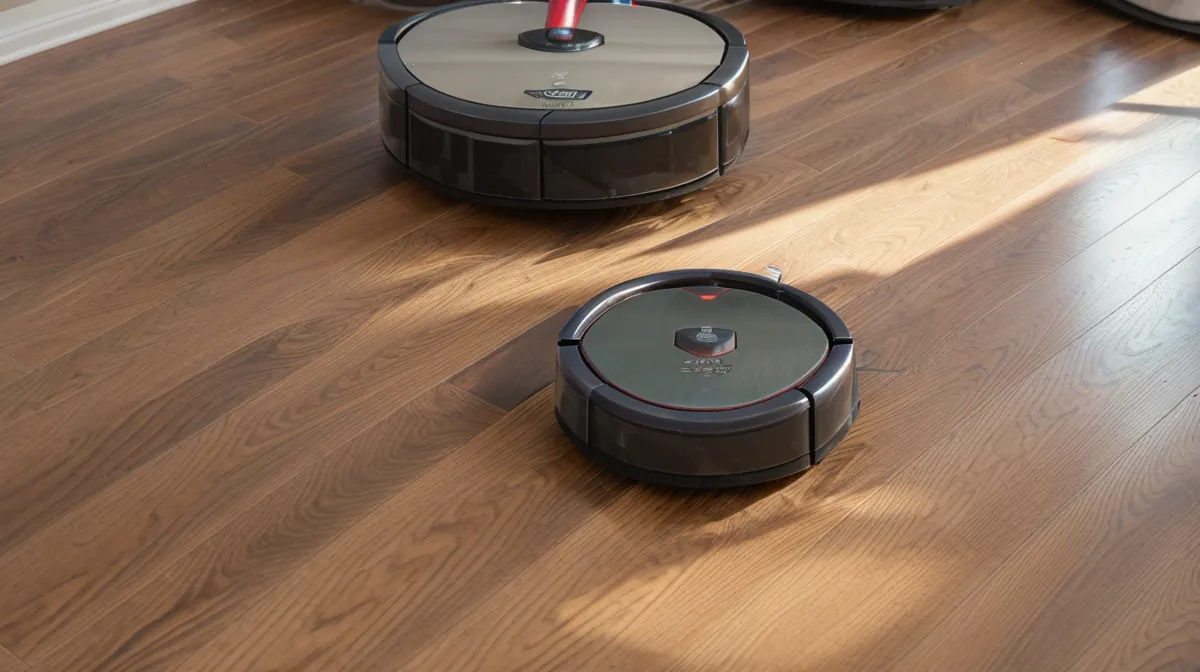
Four times. That's how many separate rescues it took before the Ecovacs Deebot X2 Omni worked itself free of the fringe on our dining-room rug — in a single run. By the fourth I'd already roped off the doorway rather than referee a repeat. That run is basically why I keep a running dustbin tally on every robot vacuum that passes through our 1920s craftsman bungalow. It's also the exact question landing in my inbox lately: does the Dreame L20 Ultra actually out-mop the Ecovacs Deebot X2 Omni, or is this just another robot-vacuum comparison where the marketing copy outworks the mop pad? Quick disclosure before the mopping-performance specifics: some of the links below are affiliate links, and I earn a commission if you buy through them, at no extra cost to you.
Murph and Beans triggered this particular comparison, honestly. Both dogs came back from a walk on the White River Greenway path with clay-colored mud caked on their paws. Watching that dry into a hazy film on the hardwood is a better stress test than anything on a spec sheet. So I put the Dreame L20 Ultra up against the Ecovacs Deebot X2 Omni across a stack of real runs, not one clean demo pass — and this is the version of that comparison I'd actually send to another pet owner asking which one to buy.
Does the Square Body Actually Clean Corners Better?
Sam's first reaction to the Ecovacs box was "why is it square." Fair question. Most bots are round, and Ecovacs built the X2 Omni's front flat specifically to reach into actual 90-degree corners instead of leaving that crescent of dust a round bot always misses. It's shorter too — low enough to get under the sectional, where Murph's undercoat likes to felt into tumbleweeds. Dreame solves the same corner problem differently with what it calls MopExtend: a small arm swings one of the circular mop pads out sideways so it can hug the baseboard, instead of relying on the whole chassis shape to do the work.
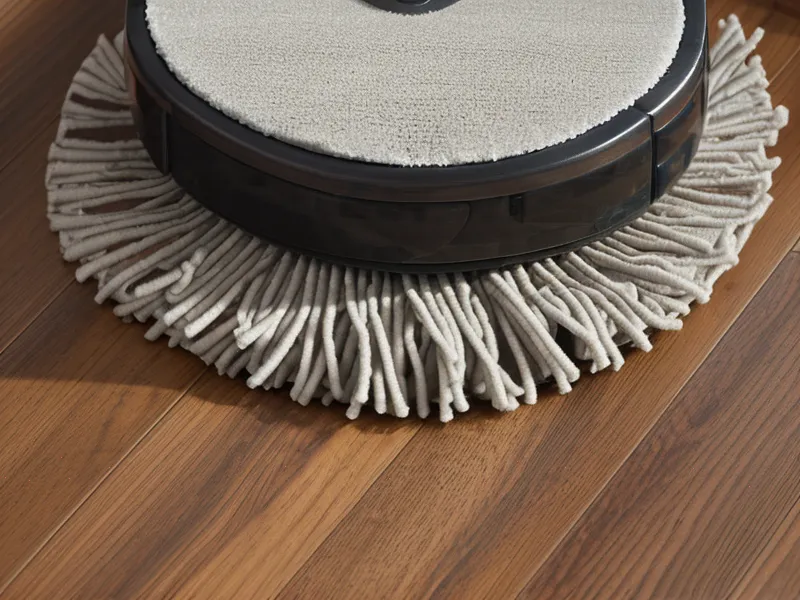
Navigation is where the two philosophies actually show up in the corners. The Ecovacs still reads the room through Lidar pulses, and it plays it a little too cautious around our heavy oak trim — it'll stop short of a corner rather than risk clipping it, leaving a strip of floor untouched. The Dreame's swing-arm gets right into that gap between floor and baseboard, exactly where Murph's fur collects. It reads less like a robot being careful and more like it actually knows where the edge is.
What Happened When I Tried No-Go Zones on the Ecovacs
One thing that flat-out didn't work: drawing a virtual no-go zone around the dogs' water bowl in the Ecovacs app. It held for a single run, then quietly reset itself back to a blank map the next time the app synced. I only caught the pattern once the bot had charged through the water bowl area again. I knew the zone had failed for good the morning I noticed Sam had quietly dragged the whole dock to the other side of the kitchen without mentioning it — he'd stopped waiting for me to notice and just started working around the bot himself.
Wet mud is the easy test. What actually separates these two mops is the dried stuff. Beans has a habit of drinking water and wandering off, leaving a hazy dried film across the dining room floor, and that's where the Dreame's dual-rotary mop heads press down harder and lift it clean in one pass. The Ecovacs gets it eventually, but it feels tuned for a flat modern condo floor, not the century-old boards in our hallway that have their own texture.
I run a PuroAir HEPA 14 Air Purifier nearby whenever I'm doing a deep mop-and-vacuum pass. Dander gets kicked into the air more than people expect during a scrub cycle. That HEPA 14 grade filter rating is its own topic I've covered elsewhere, and where you actually place a purifier in a room changes how much of that dander it catches. On its sleep setting, my iPhone's NIOSH SLM app read it at 28 dB — quiet enough that I can keep working while the floors get scrubbed.
Mop Function vs. Vacuum-Only: The Mopping Performance Trade-off That Actually Matters
Here's the actual trade-off, since I get asked this more than which bot wins. A mop function is only worth the extra money if your floors regularly get the kind of mess a dry vacuum can't lift — dried drool, muddy paw prints, syrup that dried into the grout before anyone noticed. If your home is mostly carpet, or you're mainly vacuuming dry fur and crumbs, a mop-equipped bot is carrying weight and water-tank capacity you'll rarely use. That money is better spent on stronger suction or more dustbin room instead. Dustbin capacity alone is worth its own comparison across models, since two dogs fill a small bin fast no matter how good the suction is. Empty it after a Murph-heavy run and you'll hear his undercoat let go of the rubber roller in these small static-y pops — oddly the most satisfying part of the whole process.
The trade-off cuts the other way too. Mopping mode runs slower and louder than a vacuum-only pass, since both units periodically return to the dock to rinse pads and refill water. On a floor plan near 1,500 square feet, the Dreame actually runs dry mid-mop and needs a manual refill to finish. Budget for that pause if you're covering a large open layout in one go.
Is One App Actually Less Painful Than the Other?
Short answer: yes, and it's not close. Setting up the Ecovacs app means working through a six-step account wizard with a forced country selection before it'll even show a map — the kind of onboarding friction I'd flag if a client handed it to me for review. I had to drop our router down to the plain 2.4GHz band just to get the initial pairing to stick, the same workaround I needed the first time I paired our X-Sense Smart Detectors. Familiar headache, that — smart-home cleaning gear tends to assume everyone already knows their router's band settings. Detector placement is its own separate question from pairing, too, since where you actually mount one changes how fast it catches something real.
The Dreame app isn't perfect — no robot vacuum app is — but mapping loads faster and the MopExtend frequency setting is a straightforward toggle instead of something buried three menus deep. Anyone who wants a deeper look at how it stacks up against another premium option can read my full comparison of the Roborock S8 Pro Ultra vs Dreame L20 Ultra for Homes With Pets. For a two-dog household, the Dreame just asks less of you day to day.
Clearance, Rugs, and Where the Dreame Loses Ground
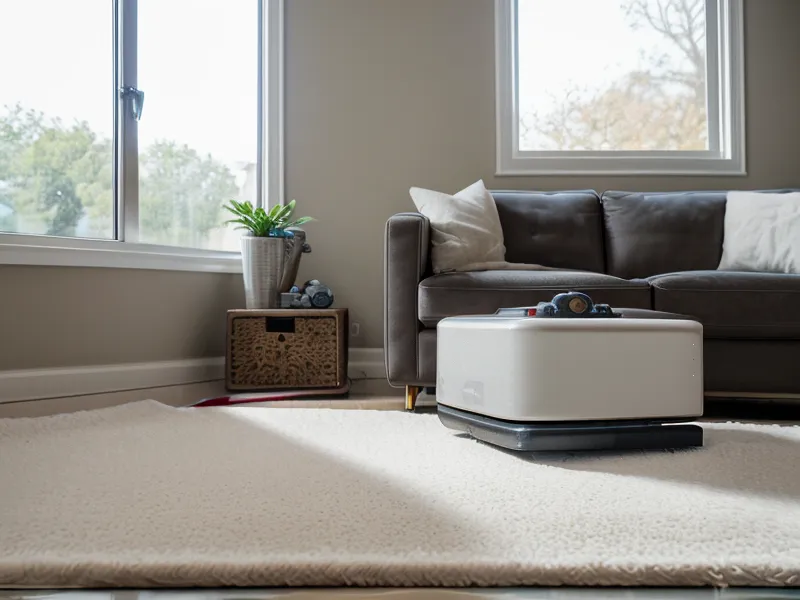
Clearance is the one category where the Ecovacs wins outright. Because it skips the raised turret and reads the room through a front-bumper sensor instead, the X2 Omni slides under furniture the Dreame just bumps into. Anyone with low-slung mid-century furniture should weight this more heavily than I did — our pieces sit high on legs, so it barely factored into my results, but your living room might tell a different story.
Brenley Hessler, who I know from the r/robotvacuums threads where I post my dustbin numbers, asked me recently whether the clearance win holds up on laminate the way it does on our hardwood. She runs her own bots on laminate and cross-checks her results against mine. My honest answer is that I can't fully confirm it: the physics of ground clearance shouldn't change by surface, but mop-pad grip and mapping accuracy both behave a little differently once you're off hardwood — that's really its own write-up. On the runner rug specifically, the Roborock S8 Pro Ultra still lifts its pads highest of anything I've tested, and its mapping locked in faster than a couple of other bots I've run through the same floor plan. The Dreame handles our hallway runner differently — it can leave its mop pads docked entirely before it vacuums carpet, which costs a bit of convenience but means zero risk of a damp stripe down the runner. The Ecovacs lifts its pads too, just not by as much, and ours still occasionally brushed against the thicker weave of that same runner.
Which One Should You Actually Buy?
My answer, for most two-dog households, is the Dreame L20 Ultra. MopExtend isn't a gimmick — it's the first swing-arm design I've tested that actually finishes an edge without me following behind it with a rag. The Ecovacs X2 Omni is genuinely well-built hardware, and it wins on clearance and corner geometry, but the app friction and the softer scrub on dried messes make it a harder recommendation for a house that generates dried messes daily. If you're weighing suction against battery life more than mopping specifically, that's a different comparison — I've written separately about how the LG CordZero Robot Vacuum Review for Cleaning Craftsman Trim and Edges handles that trade-off, worth a read if trim-edge cleaning matters more to you than mop performance.
Sam's actual verdict: "as long as it doesn't yell that it's stuck under the couch, I'm fine with it." The Dreame has stayed out of trouble more often than the Ecovacs did during testing. Pet-waste avoidance is a separate question from mopping, and it matters more if your dog is prone to accidents mid-floor — one I've answered in more detail elsewhere, since it deserves its own comparison rather than a footnote here. If dander in the air bothers you as much as dander on the floor, pair either bot with the PuroAir HEPA 14 Air Purifier and run it during the cleaning cycle itself, not just after.
One last thing that applies no matter which one you buy: you're still emptying a dirty mop-water tank by hand afterward, and after a muddy stretch of weather it is not a pleasant job. Wear gloves, and don't say I didn't warn you.