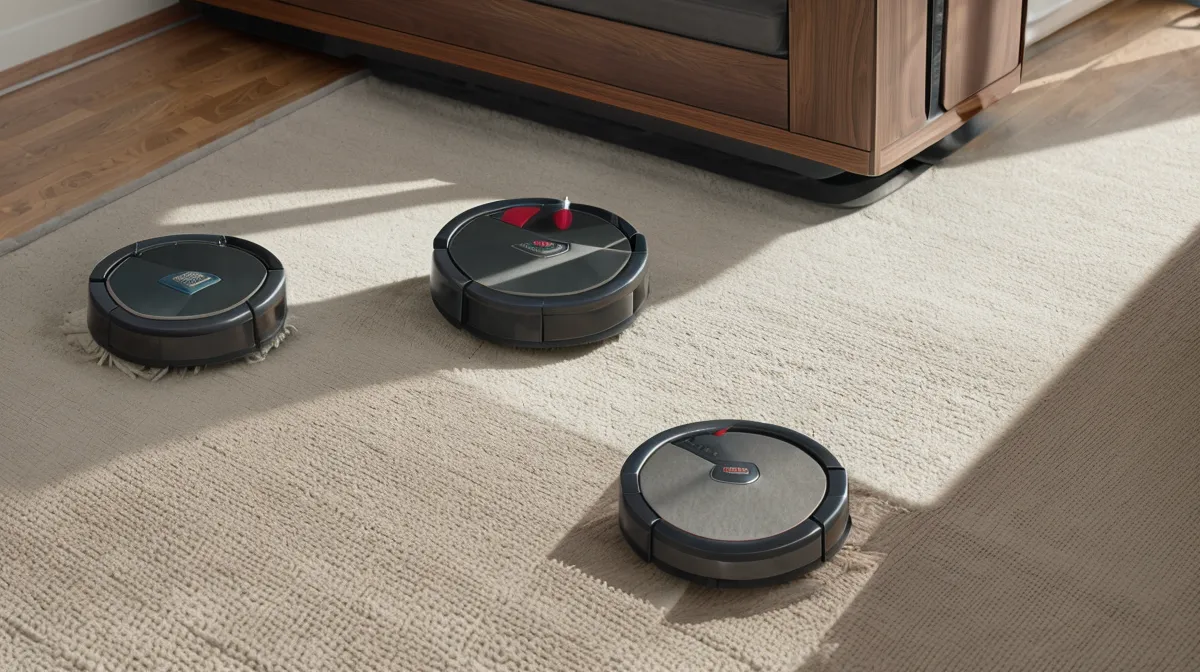
Mud dries lighter than you'd expect against ninety-year-old oak. A chalky gray ghost print replaces the dark stain you'd anticipate. Most of it starts at Sahm Park off 56th Street, where Murph and Beans detour through the wettest patch of grass on every single walk, then track it straight down our hallway. That's the real test for any robot vacuum that claims to handle hardwood floor mopping: not a demo video on a showroom floor, but dried paw prints baked into century-old boards.
Quick disclosure before the comparison: I bought the Dreame L20 Ultra and have run the Roomba j7+ long enough to trust the numbers, and I earn a commission if you buy through a link below, at no extra cost to you. Everything here comes off our actual oak floors, weighed on a kitchen scale, with two shedding dogs and Sam underfoot.
Here's the myth worth killing early: that the mop with more RPMs or more water settings is simply the "better" robot. It isn't. Not in a two-dog house. The real trade comes down to which failure mode you can tolerate, scrubbing power at the edges versus hands-off reliability around clutter, and that's the actual decision underneath this whole comparison. Murph proved how temporary even a great mop pass is, stretched back out across the hallway runner, paws still faintly damp, less than an hour after a run that left the boards streak-free. If dry fur pickup matters more to you than wet scrubbing, I already broke down which self-emptying robot actually survives a two-dog house on its own.
Two Robots, One Stretch of Hardwood
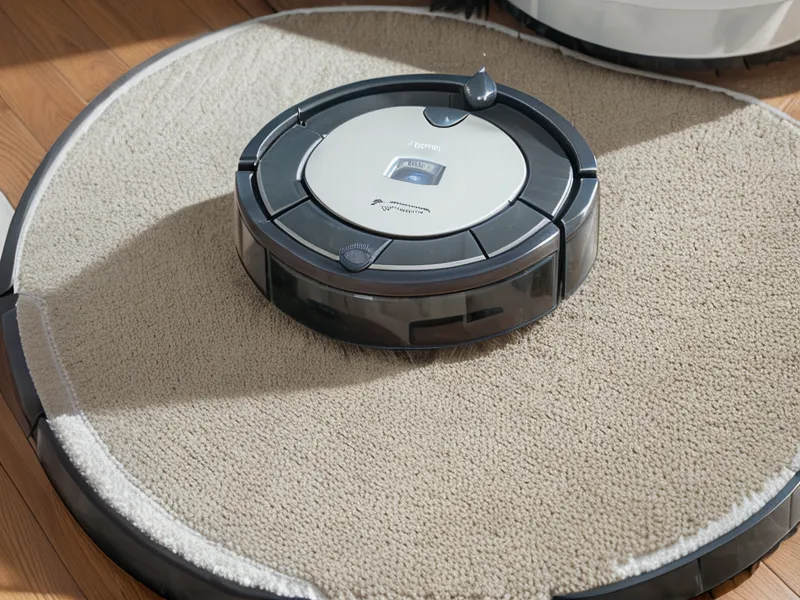
Our bungalow sits on the northwest side of Indianapolis, a 1920s craftsman with original oak underfoot through the main living spaces and one long runner down the front hall. Low quarter-round trim lines every doorway, and that trim is exactly where automated navigation tends to fall apart. Dreame and Roomba walk into that floor plan with opposite assumptions about what matters most.
Dreame built the L20 Ultra around the idea that mopping is a scrubbing job, not a wiping one. Dual circular pads spin at 180 RPM and push real downward pressure into dried paw prints instead of gliding over them, and a 10.5 mm lift raises those pads clear of the hall runner so damp pads never soak the fibers. Thirty-two separate water levels let you dial the saturation down for old polyurethane finishes that don't love standing moisture.
The iRobot Roomba j7+ starts from the opposite premise — vacuuming first, obstacle recognition doing the heavy lifting, with mopping treated almost as an afterthought via dragging pads rather than active scrubbing. That camera system is the star of the platform, and I already covered how it handles random floor clutter in my Roomba j7 Plus review for handling dog toys and random clutter.
Sam took one look at the Dreame's base station — clean tank, dirty tank, dust bag, all stacked in the dining room corner — and called it a rodent's apartment building. Fair. It eats more floor space than the Roomba's dock ever has. Prices on both move around enough with refurb drops and seasonal sales that I'd rather send you to check current listings than quote a number that'll be wrong by next month.
What Does "Smart Mopping" Actually Control?
Thirty-two micro-levels of water control sounds precise until you're hunting for the toggle in a smart home app that treats basic settings like VIP features. Dreame's onboarding flow wants account permissions before it'll let you touch a single setting — a Sephora checkout, basically, for a robot that just needs to know how wet to get. Brenley Hessler, who's been trading dustbin numbers with me since she found one of my old threads, texted last month about a companion-app update that quietly reset her cleaning schedule. Same category of problem I hit with a different brand entirely, back when the no-go zones I'd drawn by hand kept silently resetting themselves between runs, forcing me to redraw boundaries before every cleaning cycle.
Dial the Dreame down to its lightest setting and the pads leave a clean, even sheen that's dry within a few minutes, no streaking. The Roomba's dragging pad handles plain dust fine but turns any dried sticky spot into a smeared, translucent skid mark — it's a wipe, not a scrub. On pure vacuuming runs, though, the j7+ stays the quieter machine; the NIOSH app on my phone read about 63 dB off bare oak, while the Dreame's water pump and pad motors pushed noise past 68 dB on the same floor.
We ran a PuroAir HEPA 14 Air Purifier in the living room during most of these tests, mainly to catch whatever dust and dander got kicked loose mid-run. There's more on how that pairing plays out in my notes on three high-end robot vacuums and a HEPA hero.
Edge Cleaning Exposes the Real Trade-off
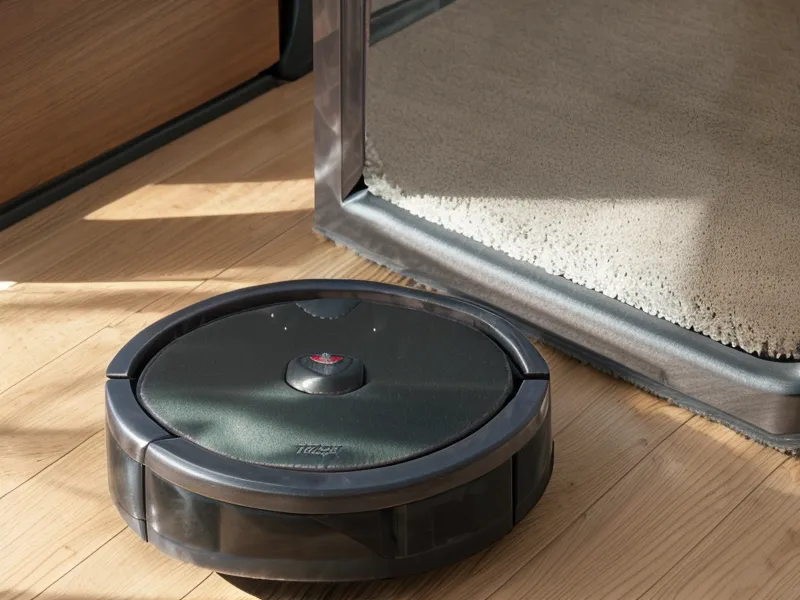
Craftsman trim creates a right angle that round robots almost never clean, and that gap is where the Dreame earns its keep. MopExtend swings the right-side pad out on a small mechanical arm the moment edge sensors spot a wall, scrubbing flush against the baseboard instead of circling two inches short of it. Watching that arm chase the dust line down our hallway the first time was genuinely satisfying — it closed a gap every other mop in this house has left untouched.
That same mechanical arm is a liability under low furniture. Our sectional sits close enough to the floor that the Dreame's raised turret occasionally catches on the underside fabric, and one run it wedged its extending arm against an awkward corner near a floor vent and just sat there chirping an error. Sam's the one who noticed — he'll call out from the other room if a bot's been stuck in the same spot for twenty minutes, and this was one of those times.
No turret means no problem for the Roomba. It ducks under that same low sectional without hesitating and comes out with the dust bunnies the Dreame can't always reach. It just won't wash the perimeter grime once it's down there — the j7+ respects the edge instead of scrubbing it.
Chasing Dried Stains Without Rewriting the Map
Beans knocked over a bowl of wet food mixed with pumpkin one afternoon, and by the time either bot got to it, the spill had dried into a stubborn kitchen stain. The Dreame's first pass lifted roughly seventy percent of it; a second pass with the pads re-engaged finished the rest, leaving the finish clean instead of gummy. It rolled back to the dock afterward to rinse and dry its own pads before any smell could set in.
The Roomba's dual rollers are excellent at pulling loose kibble and husky fur out of corners, but its damp pad had nowhere near the torque to break up dried pumpkin. It dragged a faint orange smear three feet down the board before stalling against a dropped towel.
Here's the catch nobody mentions on a spec sheet: the Dreame's structured-light vision hesitates more than the Roomba's camera does around actual household chaos. Beans leaves half-chewed rubber bones in shadowed hallways, Murph abandons braided rope toys mid-room, and that's exactly where the two platforms split.
Across every run I've logged, the j7+ has never once tangled itself in a toy or a charging cable — it photographs the obstacle, flags it in the app, and routes around. The Dreame, while competent most days, has shoved a lightweight toy clear across a room and given a wide, unnecessary berth to dark floor patterns it mistook for a hazard.
Other bots in rotation make the same trade-off in different shapes. The Roborock S8 Pro Ultra maps faster than either of these two and lifts its mop pad on carpet detection, though that lift sits a touch tighter than the Dreame's 10.5 mm clearance on thicker thresholds. The LG CordZero Robot is still the strongest pure vacuum in the lineup but skips active wet scrubbing entirely, which rules it out for mud season. And in the utility room, we keep a X-Sense Smart Smoke and CO Detector running, mostly for peace of mind on nights the Dreame's dock runs a long heat-drying cycle.
Self-Cleaning Docks Still Need You
Calling an all-in-one dock hands-off skips the weekend routine entirely. Every four or five days of wet-weather use, the Dreame's dirty water tank needs dumping and rinsing, and forgetting it for a week turns the lid into a swamp-smell surprise that'll clear the dogs out of the kitchen. The washboard tray under the dock also catches fine husky undercoat that slips past the rollers, so it gets a sink scrub every couple weeks on top of everything else — all while the app nags with maintenance percentage bars like a guilt trip with a progress meter.
The Roomba's base station barely asks for anything by comparison. A sealed bag swallows dry fur for roughly two months at a stretch, no tanks to sour and no heating element running for hours to dry fabric pads. It's built for someone who'd rather not maintain the machine that's supposed to be doing the maintaining.
So Which One Actually Belongs on Your Hardwood?
If your household runs on dry fur, scattered dog toys, and floors that just need steady daily upkeep, the Roomba j7+ is still the one to trust around clutter. It won't wash away a dried mud track, but it also won't shove Beans's chew toy into a corner or wedge itself under the couch trying.
Heavy shedding, muddy yards, and baseboards that collect grime the Roomba can't reach change the calculus — the Dreame L20 Ultra earns its extra dock maintenance in that situation. Measure the gap under your lowest piece of furniture before deciding, then count how often dried stains outnumber stray toys on your floor. Low clearance and a toy-strewn living room point toward the Roomba; muddy entryways and bare baseboards point toward the Dreame. That's the actual choice, not which spec sheet reads more impressive.
| Product | Rating | |
|---|---|---|
| Dreame L20 Ultra Best Edge Scrubbing | 8.8 | Read More → |
| iRobot Roomba j7+ | 8.5 | Read More → |
| Roborock S8 Pro Ultra | 8.3 | Read More → |
| LG CordZero Robot | 8.1 | Read More → |
Dreame L20 Ultra
Pros
- + MopExtend arm reaches flush against craftsman baseboards and cabinet edges
- + Dual 180 RPM rotary pads scrub dried muddy dog tracks instead of smearing them
- + 10.5 mm mop lift clearance prevents damp transfers onto thin area rugs
- + Granular 32-level water volume control protects vintage hardwood finishes
Cons
- − Massive dock requires dedicated floor space and regular dirty water tank dumping
- − Companion app onboarding and menu hierarchy feel cluttered and tedious
- − Taller LiDAR turret can wedge under low-clearance living room furniture