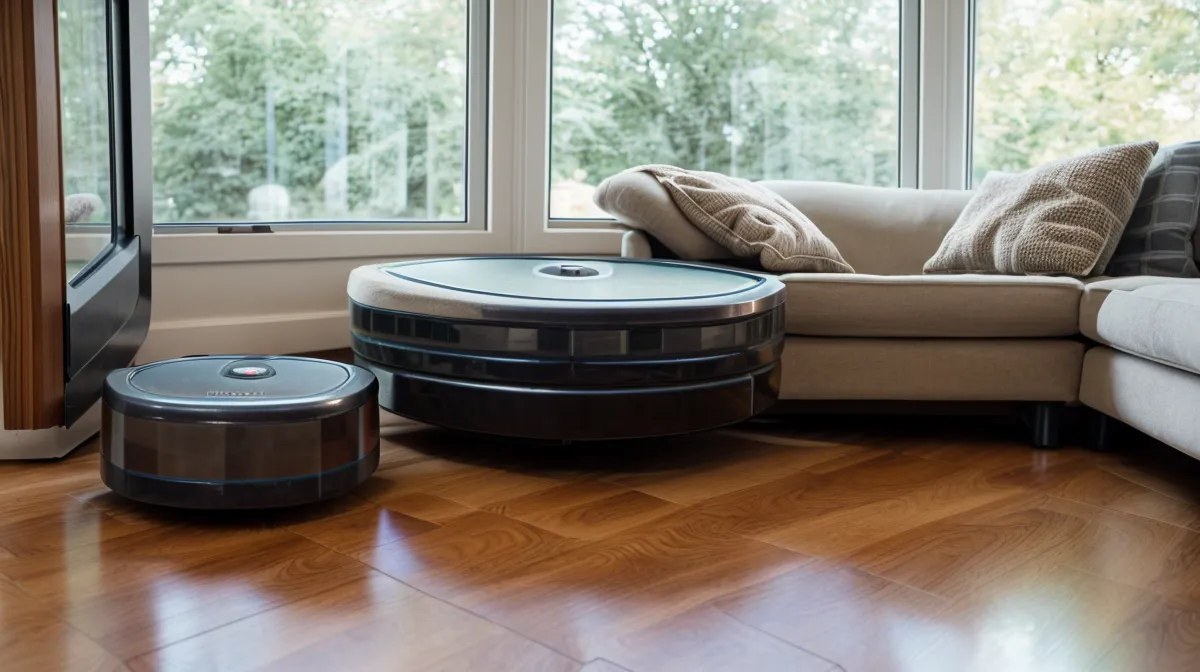
Nine grams. That's what the kitchen scale read after our last run through the hallway, less than the dustbin tally usually shows off that stretch of rug, and the difference came down to one thing: the bot finally cleared the rug edge without stalling out. Robot vacuum maintenance in a house with two shedding rescue dogs and a nineteen-twenties floor plan is mostly a fight against thresholds, not dirt, and pet hair is what turns a survivable half-inch lip into a wall. Smart home marketing likes to promise that bungalow living gets simpler once you hand the floors off to a bot, but in a craftsman house with original hardwood and one long runner down the main hall, that promise depends entirely on whether the thing can climb.
Manufacturers list a standard climbing limit around 20 millimeters for most bots, which sounds generous until a strand of husky undercoat or a loose thread from an rug edge winds around the axle mid-climb. Height isn't really the obstacle. What trips a bot is whatever grabs the wheel or the side brush right as the motor tries to power over the lip, and our hallway runner sits close enough to that limit that it's become the single test separating a bot that finishes the room from one that calls for help halfway through.
My Rug-Heavy Bungalow vs. My Neighbor's Tile Floors
My neighbor across the alley, Yusuf, has never once texted me about a stuck robot. His floors are tile from the front door to the back, he keeps one short-haired cat, and his bot has nothing to climb and barely anything to shed. Setting his living room next to ours isn't really a comparison between two vacuums, it's a comparison between two houses, and it's the clearest evidence I've got that the rug is doing most of the damage, not the dog hair by itself.
Our hallway tells a rougher story. The runner stretches the full length of it, the sectional in the living room leaves a bot maybe three inches of clearance to duck under, and the stairwell down to the basement off the kitchen still doesn't have a permanent gate on it, which is exactly how our first Roomba met its end. None of that is unusual for a house this old. It just means every bot that comes through here gets tested by a floor plan that was never built with a disk-shaped robot in mind.
What a Flagship Sensor Tower Buys You on a Rug Edge
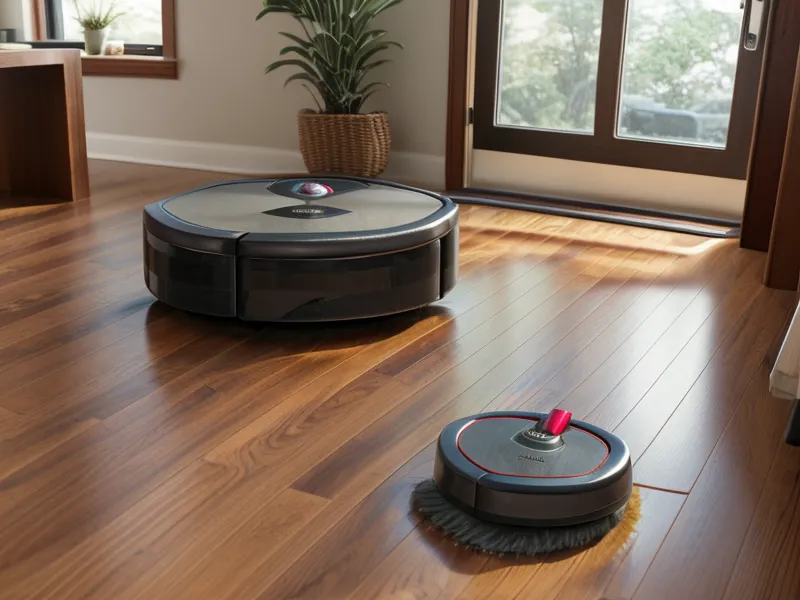
The flagship model with the pop-up LiDAR tower and camera-based obstacle avoidance struggled here in a way Yusuf's plain bump-and-go unit never would, and it wasn't because the mapping was worse. It was because there were more parts for rug fiber to grab onto. Fur worked its way into the sensor housing until the tower stopped popping up cleanly, and the bot would sit at the rug edge second-guessing the climb instead of just taking it. A mid-range bot with a basic infrared bump sensor doesn't pause to think about the threshold. It drives at it, and on a floor plan like ours, that turns out to be the more reliable behavior even when the spec sheet reads worse on paper.
A friend of mine breeds Bernese mountain dogs, and her dog sheds worse than Murph does in a bad month. Her bot is a mid-range model with none of the fancy vision hardware, and it still clears her front hallway rug most days as long as she pulls the axles clean once a week. That lines up with what I've seen after a muddy loop around the Broad Ripple Park dog trail with Murph and Beans: the bots that skip the sensor tower spend less time stalled and more time actually cleaning.
Why Lint Rollers Never Touched the Real Problem
Before I figured out the axle was the real issue, I ran a sticky lint roller over the couch cushions between every vacuum cycle, on the theory that less loose fur floating around the room meant less fur working its way into the brushes. It changed nothing. The fur causing the rug snags wasn't drifting in from the cushions. It was coming straight off the dogs and onto the floor, and a roller worked over the sectional was never going to touch that.
Meanwhile the app onboarding for most of these bots is its own separate disaster. Six screens of permissions requests before it'll even let you name a room. A pairing process that insists on one specific wireless band while your mesh router keeps shoving the connection onto the wrong one. Sam has heard me swearing at a "handshake failed" error from two rooms away more than once. "Just use the broom," he said, only half joking, after one bot's setup screen made me uninstall and reinstall the app twice before it would even find the dock. If you want the long version of which bots survive our stress test without an app-induced headache, I keep updating the pet hair spreadsheet results as new runs come in.
Is a Simpler Bot Actually the Smarter Buy for Rug Houses?
Usually, yes, and smart vacuums still get stuck in old houses no matter how many sensors they're carrying, because sensors don't fix a threshold problem. Fewer moving parts around the brush housing means fewer places for fur to jam the works before the bot even reaches the rug. I still swap the HEPA filters on my own schedule rather than the app's, because a clogged filter saps exactly the suction a bot needs to power up and over that rug edge, and a weak motor stalls on the threshold before it ever gets a chance to climb.
If your floors are mostly hard and open the way Yusuf's are, the flagship sensors earn their keep, since there's nothing for them to snag on and the faster mapping genuinely saves time. If your hallway has a rug anywhere near that 20mm limit and a dog shedding onto it daily, skip the sensor tower and go with the simpler bot instead. It'll spend less time stuck at the edge and more time actually finishing the room.
The Robot Vacuum Maintenance Habit That Actually Fixes Rug Snags
The actual fix was never a setting buried in the app. It was clearing the axles every week, before the fur had time to pack down into a solid cord around the brush spindle. Fifteen minutes on the kitchen counter, bot flipped over, side brushes off, main roller out, that's the whole routine now. Once the axle spins freely again, the bot has enough torque left to power through the rug edge instead of stalling on it, and that's the difference between that small click when the dustbin lid pops loose after a full run and the distress chirp of a bot that gave up three feet short of the hallway.
Choosing Between Flagship and Mid-Range When Rugs Are the Real Test
Beans still eyes every bot like it broke into the house uninvited, and Sam still shakes his head at the sight of brush axles drying on a dish towel by the sink. But the rugs get cleared now, most runs, without anyone standing over the thing coaxing it across the threshold. The choice isn't about which bot carries the most sensors. It's about matching the bot to the floor plan you actually have, then keeping the brushes clear so whatever torque it does have can go toward the climb instead of fighting a clogged axle.