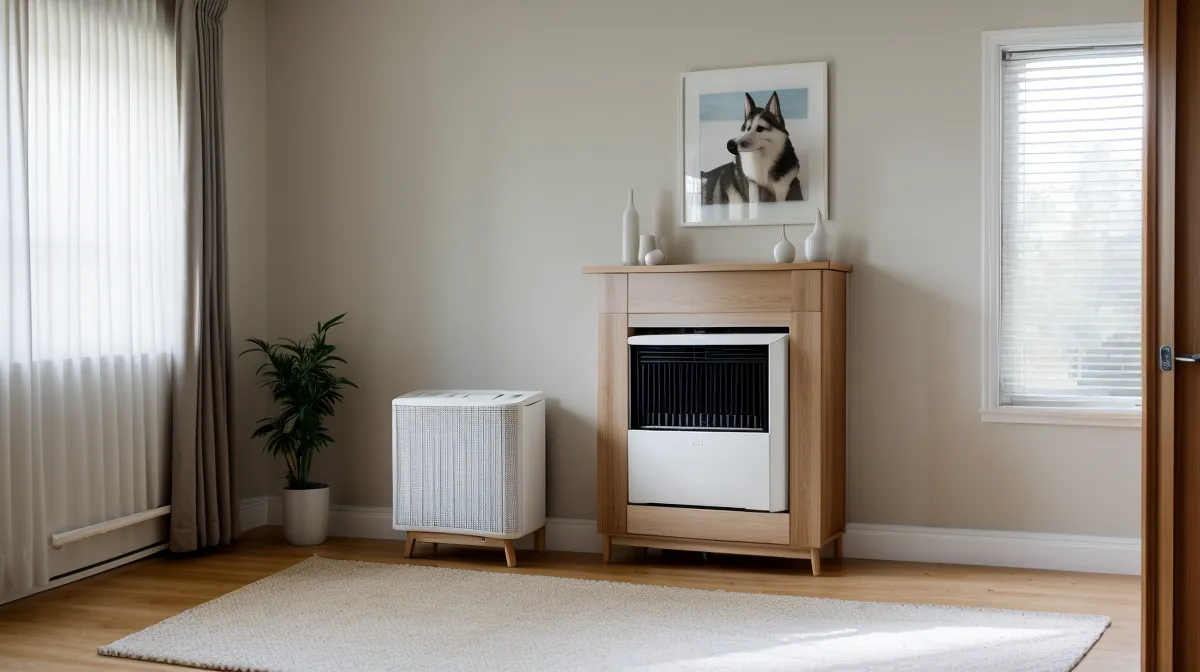
The pre-filter on this air purifier comes out a visible shade of grey within days in our house. That's dog dander — the fine stuff that never touches the floor, so the vacuums downstairs never catch it, no matter how many passes they log.
Quick disclosure before any of this goes further: I earn a commission if you buy through the links here, whether it's a robot vacuum or an air purifier like the PuroAir HEPA 14. It costs you nothing extra, and everything below comes from running this thing next to the vacuums I already track for the dustbin tally.
Two Ways to Fight Dog Dander in a Small House
Our Craftsman bungalow was built in the 1920s, long before anyone worried about airflow for two shedding dogs. One HVAC return struggles to pull air from the back of the house, and between Murph blowing his double coat twice a year and Beans parked on the rug most afternoons, dander settles into corners the vents never reach. A vacuum can only ever solve half of that problem — it gets what's already landed on the ground.
For a while I tried solving it from the floor side alone — running the LG CordZero Robot twice a day instead of once, hoping extra passes would beat Murph's shedding before it resettled into the rug. It didn't work. The brush roll wore down and needed replacing in about six weeks, way ahead of schedule, and the dustbin tally barely moved. That's the same running spreadsheet where I stack the iRobot Roomba j7+ up against the LG run for run, the numbers behind the Two Dogs and a Bungalow Stress Test, and it tracks dustbin capacity, mapping accuracy, and how many runs a brush roll survives before it needs unwinding — useful for picking a vacuum, useless for the smell that lingers after the vacuum's already done.
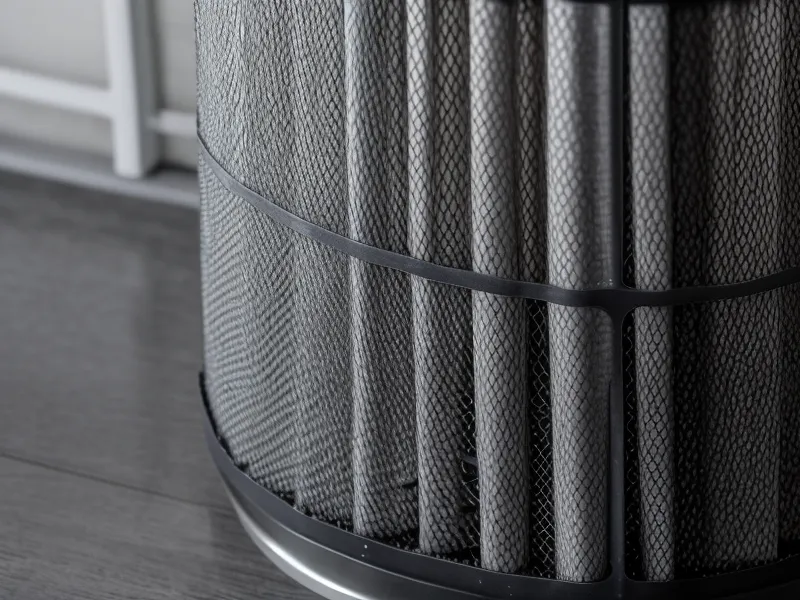
What the HEPA 14 Grade Actually Buys You
What actually changed things was swapping a Levoit Core 300 for a HEPA 14 unit, a grade above the HEPA 13 you'll find in most consumer purifiers. I won't turn that into a filtration-class lecture; that's its own write-up, but the finer grade is the reason this one pulls dander the old unit let through. Pop the vacuum's dustbin open over the trash can and a thin cloud of dust drifts up before it settles; that's roughly the scale of what the purifier is quietly pulling out of the air all day so neither of us has to breathe it in first.
There's a version of this that plays out every time the Roborock S8 Pro Ultra finishes a run: the floor looks clean, but the air in that room still reads dog for a while after, because fine dander stays suspended long after the visible fur is gone. That's the gap an air purifier is built to close, not a vacuum, however good its suction.
Does the App Get in the Way?
Short answer: yes, at first. Pairing the PuroAir meant flipping my phone's wifi settings back and forth, the same dance I went through the week the X-Sense Smart Smoke and CO Detector refused to see anything but a 2.4GHz signal — both devices want an older, slower band, and neither onboarding flow says so until the connection fails. Where you'd actually mount a smart smoke detector in an older two-story place is its own can of worms I've gone into elsewhere; the short version here is that network requirements are never obvious until the app throws an error.
Once it's paired, the app itself is thin, a basic on/off timer, nothing like the multi-step account wizards some robot vacuums put you through. Compared to the onboarding of high-end robot vacuums, which can feel like a retail checkout with extra steps, the PuroAir app is almost refreshingly boring. Yusuf, my neighbor across the alley, still texts me an occasional reliability update on his Dreame, with no app complaints, which says more about a low bar than a high one. The purifier's plastic housing feels similarly unfussy: light enough to carry room to room, but it won't fool anyone into thinking it's sitting next to the LG in a premium lineup.
Trading Quiet for Faster Odor Control
Crank the PuroAir to its highest fan speed and the dog smell clears out fast: about twenty minutes in a room this size. On days I actually need quiet to get copy written, I take the laptop to one of the coffee shops on Mass Ave instead of fighting the noise in my home office. Sam mutes the TV and says, "that's the purifier, right?" every time it kicks up that high, which tells you how far it is from background noise on that setting.
Sleep mode is where it actually lives day to day. My phone's decibel meter reads it at 28 dB from a few feet away, quiet enough that it disappears under normal house noise the way a compressor running in my friend's garage disappears once you're used to him restoring vintage motorcycles out there most weekends. Leaving the purifier on that low setting around the clock keeps the smell from ever building up enough to notice, which turned out to matter more than blasting it once a day ever did. It also keeps dander from settling into the runner rug in the hallway, the same rug fringe that robot vacuums keep choking on if you don't rope it off first.
Where the Sectional and the Stairwell Still Win
None of this replaces the floor side of the equation. The sectional sits low enough that not much fits underneath it, purifier included, it just moves air past that gap, it doesn't reach into it, and whatever settles down there still needs a vacuum with decent low-clearance navigation to go get it. The open stairwell off the kitchen is the other reminder: no permanent gate on it, so any bot working that side of the house needs a drop sensor that actually stops at the edge rather than one that treats a step down as just another patch of floor. That's the kind of failure that ends a robot vacuum's run entirely, not just its filter life.
A vacuum with real pet-waste avoidance solves a different emergency than a purifier ever will, and a rug thick enough to need proper carpet deep-cleaning wants contact the purifier can't give it — those stay floor problems, obstacle avoidance and all, no matter how fine the filtration gets upstream. Even the mop-versus-vacuum debate people have over a machine like the Roborock is a floor argument. None of it touches what's still floating in the air an hour after the bot's back on its dock.
Which One Should You Buy First?
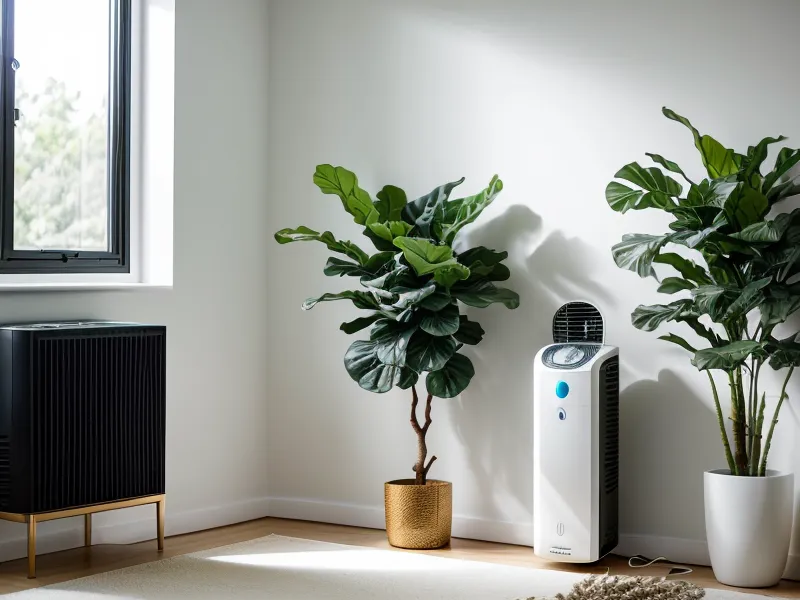
If a vacuum is still choking on rug fringe or skipping half the house on the first few runs, fix that side first — no amount of air filtration makes up for fur still sitting on the rug, and you might still end up wanting more suction and a longer track record for the actual mud and hair, which is still a job for something like the Roborock S8 Pro Ultra. But if the dogs are heavy shedders and the floor is already handled, a decent bot running its normal schedule, no twice-a-day heroics required, the air is the real gap left to close, and that's when the PuroAir HEPA 14 earns its spot in the corner of a room. Buy for the floor when the floor is the failure. Buy the purifier when the floor is fine and the smell is what's left, this is the one that's earned the spot by the window in a house that smells like two dogs live in it, no matter how often the floors get run.
PuroAir HEPA 14 Air Purifier
Pros
- + Medical-grade HEPA 14 filtration actually kills the 'dog smell'
- + Sleep mode is 28 dB quiet—perfect for Indianapolis traffic masking
- + Light enough to carry between rooms without a struggle
- + App replacement schedule is honest and not a sales-trap
Cons
- − Plastic build feels a little cheap for the price point
- − App is very basic with limited scheduling options
- − Only connects to 2.4GHz networks