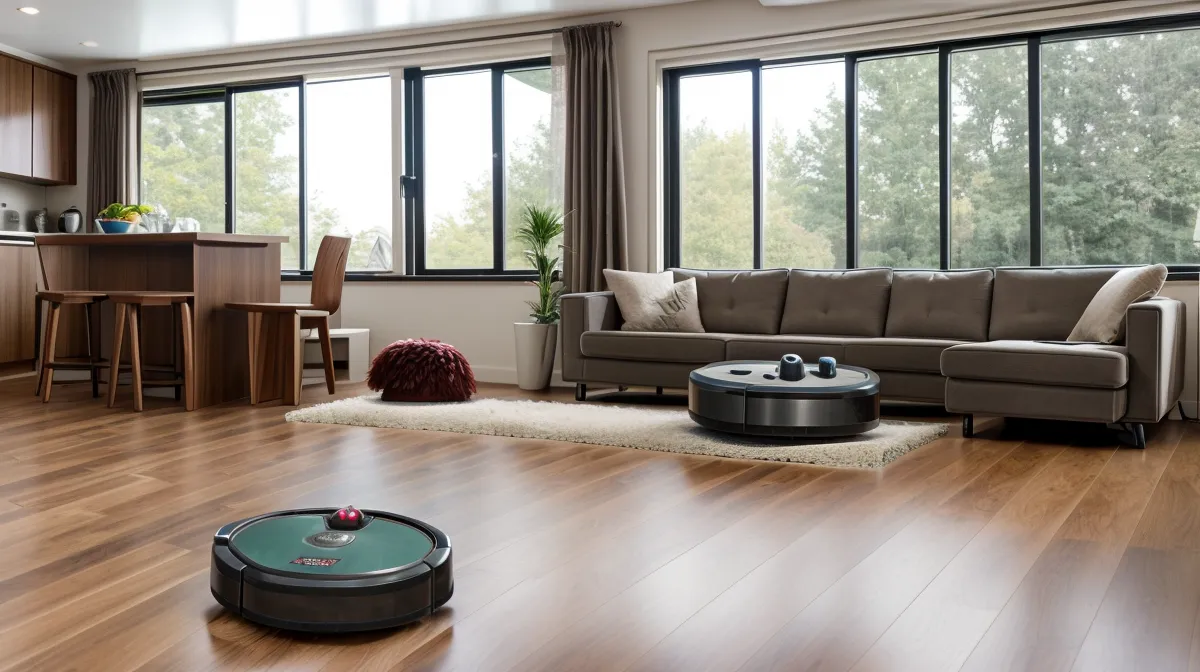
Husky undercoat doesn't just sit on hardwood — it skids into these dense little drifts that stack up against the baseboards no matter how flat the floor is. That's the kind of pet hair a robot vacuum has to deal with in our house, on top of thick carpet in two rooms, and it's why most of the seven bots I've run through here start strong on the low-pile spots and then quietly give up once they hit the plush stuff. Sam watched bot number six trundle straight past a visible drift of Murph's fur last week and said, "I don't think it even saw that."
Quick disclosure before any of this: some of the robot vacuum and smart-home links below are affiliate links, and I earn a commission if you buy through one of them — a Roomba, a Roborock, whatever ends up making sense for your floors. Doesn't cost you anything extra on your end. Every bot mentioned here has run through my own house on my own carpet, and the dustbin tally comes off my kitchen scale, not a press release.
Seven Vacuums In, and Murph Still Wins
Ever since that Roomba i3 died on the basement steps back in March 2024, I've kept a running tally of every bot that comes through this house. Seven vacuums in, thick carpet is still the one variable that separates a genuinely good bot from one that just has a good marketing page; the runner in the main hall gets treated like a minor bump by most of these things, while the bedroom carpet gets treated like a swamp they'd rather avoid. Dustbin capacity is the number I trust more than any app's bin-full alert at this point, and I've gone deep on the actual gram readings in that tally piece; the short version here is that a bigger bin beats a flashier spec sheet once Murph and Beans are both shedding at the same time.
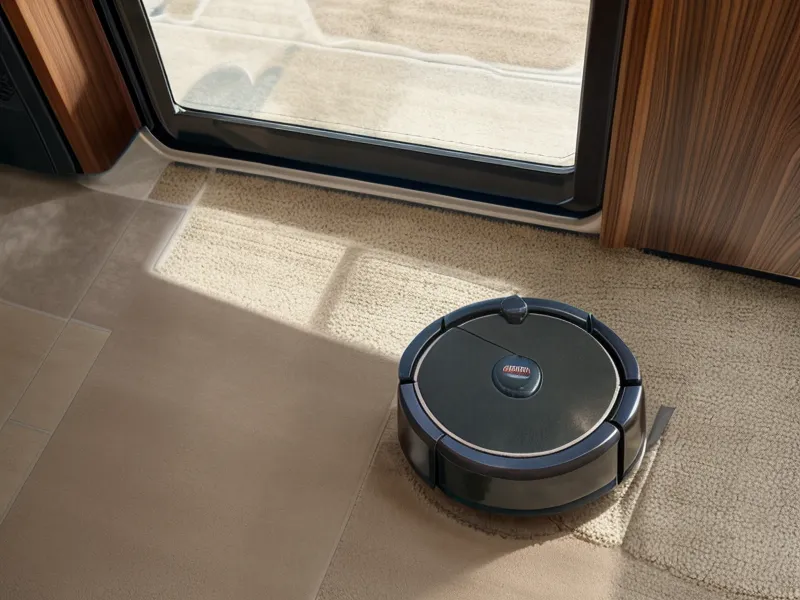
Running the Bot Twice a Day Cost Us a Brush Roll
Somewhere in there I tried the obvious fix: running the bot twice a day instead of once, figuring more passes would keep up with how much Murph sheds after a hot walk at Sahm Park off 56th Street. By week five I could already tell it wasn't working — Murph would resettle on that same stretch of hardwood before I'd even started the second room, undercoat drifting back into the grain like the extra run hadn't happened. By week six the brush roll had actually worn out from the doubled use, the rubber fins flattened enough that it stopped picking up anything on the runner. That's when it clicked that running a bot harder doesn't fix a shedding problem — it just decides which part fails first.
Why the LG Keeps Digging Into Thick Carpet
The LG CordZero Robot is still my pick for actual thick-carpet performance, and it's not close. Three suction stages that behave like three different machines instead of three volume settings, and on the bedroom carpet it genuinely digs in instead of riding on top of the fibers. There's a trade-off buried in that, one I go into with actual runtime numbers in the LG battery piece elsewhere; bumping the top suction stage on thick carpet burns through the battery noticeably faster, so you're choosing between a deeper clean and a shorter run before it needs to dock. Mapping took three full passes before it stopped eyeing the basement stairs like it wanted to attempt them, which is its own rabbit hole I've measured on other bots too — here it's enough to say patience pays off once the map actually locks in.
Sam noticed the app before I did, actually, which almost never happens. The onboarding didn't ask for six permissions and an account before letting us start a map. None of the forced-country-selector, verify-your-email-twice nonsense some of these apps pull. It just worked, more or less immediately. What it hasn't solved is the long-hair wrap: every ten runs or so I'm sitting on the floor with the brush roll in my lap, unwinding my own hair from it, and flipping a just-finished unit upside down always gives off this warm, faintly plastic smell off the motor housing that I've come to associate specifically with pulling hair out of brush bearings.
The Greenie Incident and the Roomba j7+
Beans, our senior beagle, lost an argument with a Greenie dental treat on the living room rug one afternoon, and if you've ever had a robot vacuum roll straight into that kind of mess in the dark, you understand why pet-waste avoidance matters more than almost any other spec on the list. This is where the iRobot Roomba j7+ earned its keep. It saw the mess and steered around it, no drama, no cleanup on top of cleanup. I've written up my experience using the Roomba j7 Plus for pet waste avoidance in more detail elsewhere, so I won't repeat the whole thing here, but it remains the one I'd point a household with a dog like Beans toward first.
Reliability's real with this one. The app, though, is a nag — it tries to upsell a Premium subscription every couple of weeks even after you've said no twice, which starts to feel less like a feature reminder and more like a retail clerk trailing you around a store asking if you want store credit. Auto-empty seal is the strongest of any base I've tried, no dust leaking out around the dock, which matters a lot with the amount of dander a beagle throws off. The dustbin itself runs smaller than the LG's, so you're emptying more often for the same square footage — a trade worth knowing before you commit to it.
Beyond the Floor: Dander and Detector Placement
Floors are only half of it in a house this old — the air gets heavy fast with two dogs shedding into it. I started running the PuroAir HEPA 14 Air Purifier back in May, and the dog smell noticeably dropped within a couple of days. It's a step up from the HEPA 13 grade most purifiers ship with, though I won't relitigate the whole filtration-grade conversation here since I already went deep on that in testing the PuroAir HEPA 14 for persistent dog dander. In short, it pulled more dander out of the air than anything else I've run. Sleep mode reads 28 dB on the NIOSH SLM app on my phone from three feet away, the quietest thing in this house by a wide margin, and where you actually put the unit changes those readings more than the spec sheet does — that's its own conversation I've had in more detail elsewhere.
Same story with the X-Sense Smart Smoke and CO Detector we swapped in for the old landlord units. The real win is the push notification landing on my phone roughly four seconds before the in-house horn goes off, so a smoky pan doesn't turn into a full alarm event with two dogs losing their minds over it. Where you mount these in an older two-story place matters enough that I've written a separate guide on it, so I'll skip the full argument here. Pairing failed twice on our 5GHz network before I dropped it down to 2.4GHz, the kind of afternoon a friend down the street — the one who spends his weekends restoring a vintage motorcycle in his garage — says he recognizes from troubleshooting the electronics on his own old machines. Hardware's fine. Getting the hardware to talk to the app is where it goes sideways.
The Roborock's Mop Lift Is Great, the App Is a Smart-Home UX Mess
For a mixed-surface house — carpet in some rooms, tile or hardwood in others — the Roborock S8 Pro Ultra is the one Sam actually likes best. The mop-pad lift is the only feature I've tested that reliably keeps a wet mop off carpet without a manual step; it catches the change in surface friction almost instantly and lifts before it ever touches the rug fibers. Sam's reaction the first time it worked: "Okay, that's actually smart." There's a mop-versus-vacuum trade-off worth knowing about too — mopping mode adds real cleaning power on hard floors but slows the whole run down, and I've compared that trade-off directly on two other bots elsewhere if you want the specifics.
None of that goodwill survives the app. It's feature-dense to the point of exhaustion, more like navigating a professional editing suite than telling a robot to stay out of the dogs' water bowls. My neighbor across the alley, Yusuf, has tile floors and one very unbothered short-haired cat — a completely different problem than thick carpet and two shedding dogs — and even he said the app took him longer to figure out than setting up his own router. If your idea of smart-home UX is something you can hand off to whoever's less patient in the house, this isn't it.
Comparison: Top Robot Vacuums for Heavy Shedding
| Model | Best For | Suction Strength | App UX Rating |
|---|---|---|---|
| LG CordZero Robot | Thick Carpets | High (3 stages) | 4.5/5 |
| Roborock S8 Pro Ultra | Mixed Surfaces | High (Dual Brush) | 3.5/5 |
| iRobot Roomba j7+ | Avoidance | Medium-High | 4.0/5 |
What Actually Changed by Week Five?
Week five is the marker I keep coming back to, because that's when the twice-a-day experiment made it obvious that frequency alone wasn't the fix — Murph's shedding volume needed a bigger bin and tougher brush hardware, not just more passes with the same one. That's the actual lesson here if you're picking a bot for thick carpet and heavy shedding: match the bin capacity and brush durability to how much your dogs actually shed, then worry about suction stages and app polish after that.
If you're dealing with thick carpet and dogs that shed like Murph and Beans, start with the LG CordZero Robot for raw carpet performance, or the Roborock S8 Pro Ultra if a mixed floor plan means you need the mop-lift function too — both have outlasted everything else in the tally so far. Either way, you're still the one unwinding hair from the brush roll some weekend. That part never gets automated.