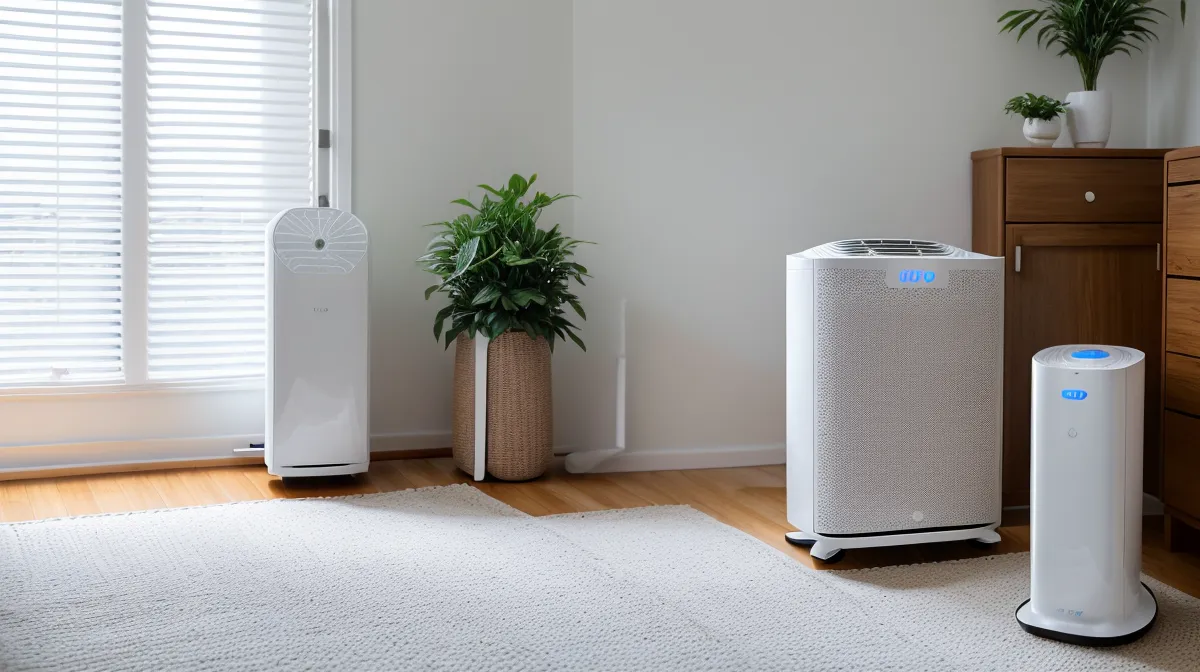
Does a manufacturer's decibel number tell you anything about what a room will actually sound like once a reactive dog is asleep in it? Sit with that question, because most air-quality gear gets sold on a spec-sheet number that has nothing to do with real noise-testing, and the sleep-hygiene advice written for pet-care households almost never accounts for what happens the second a sensor decides the room needs more airflow.
Before any of that: I get a small commission if you buy through the links below, at no extra cost to you. Two years of dustbin-tally spreadsheets and receipts have shaped the bias here toward whatever actually survives Murph blowing his undercoat out in our bedroom, not whatever pays the best rate.
The 28 dB Number Isn't the Whole Promise
Sam is the one who wakes up if a floorboard creaks, so when the dander got bad enough this past winter that our old Levoit Core 300 couldn't keep up, I wanted something that wouldn't trade dust control for a new kind of insomnia. Our floors are original hardwood through the main rooms, with just one runner in the hallway, so anything mechanical announces itself here in a way carpet would swallow. That's what sent me looking at the PuroAir HEPA 14 — its sleep-mode spec reads 28 dB, and on paper that's exactly the number a light sleeper builds a purchase decision around.
There's a reason a HEPA 14 stack needs a specific fan speed to hit its rated capture, and that fan speed is exactly what shows up as decibels at your bedside — a trade-off I've mapped out filter-by-filter in a separate write-up, so I won't repeat the math here, but know that the two numbers are connected before you shop on the sleep-mode spec alone.
Noise-Testing the Sleep Setting, Three Feet From the Bed
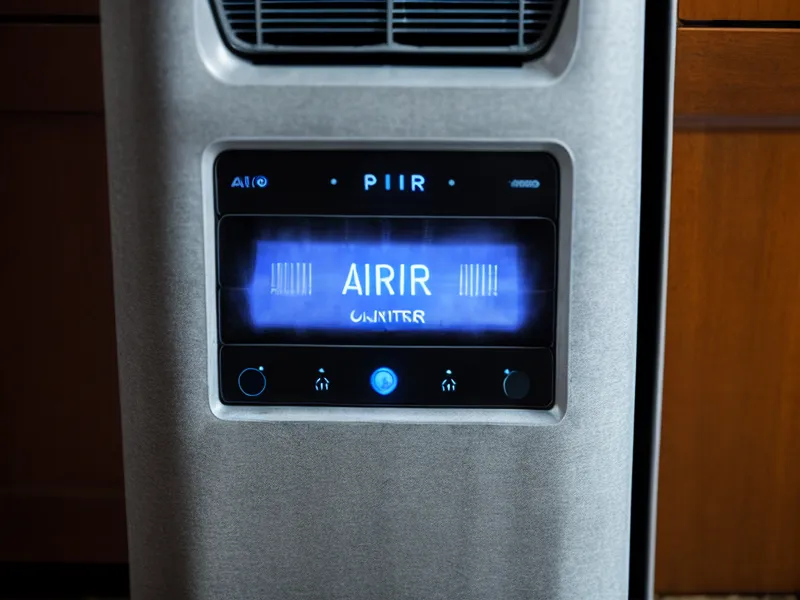
I ran the actual noise-testing the plain way: phone on the nightstand, the NIOSH sound level meter app open, the PuroAir HEPA 14 humming on its lowest setting about three feet away. The reading bounced between 27 and 29 dB the whole time, which tracks with the spec, and Murph's breathing from the floor genuinely read louder than the machine on the same app.
"Is that thing even on?" Sam asked, looking up from his book without any prompting from me. Some nights the only other sound in the room is the vacuum's bumper catching a sectional leg, a soft little knock before it reverses and tries a new angle, and even that got swallowed once the purifier replaced the Levoit's rattle.
For anyone tracking noise the way I do across the whole lineup, this reading lines up with how I log everything else on the Robot Vacuum Specs Compared: Suction (Pa), Bin Size, and Battery Reference page — same phone, same app, different device.
The App That Doesn't Exist
My UX-writer brain still isn't over this part. Ten minutes went into hunting for a pairing button before I accepted that the PuroAir simply doesn't have a companion app — no schedule, no remote toggle, nothing to check from bed. Compare that to the X-Sense Smart Smoke Detector, which at least gives you a dashboard even with rough onboarding, or the Roborock S8 Pro Ultra, where the app scripts fan behavior down to the room. The PuroAir gives you buttons and a color-changing light. That's the whole interface.
Where you actually place either device changes a lot of this, which is its own separate question I won't get into here, and the same goes for where a smoke or CO detector belongs in an older two-story floor plan — a placement problem all its own. What I can say about the PuroAir specifically is that no scheduling means no automatic ramp-down before bed; I have to hit the button myself every night or live with whatever speed it landed on.
Why Does the Same Purifier Sound Twice as Loud an Hour Later?
Here's the myth worth correcting: that a purifier's Auto mode is strictly an upgrade over a fixed setting because it reacts to real particle spikes. On paper that's true. In a house with a noise-reactive dog it's the opposite of restful, because the sensor can't tell the difference between something worth reacting to and Sam cracking the back door for two minutes.
Before this unit, my fix for the dander was running sticky lint rollers over the couch cushions between every vacuum cycle, and it did next to nothing for what stayed airborne — it just made the cushions look clean while the actual particles kept circulating. What changed my mind happened on an ordinary vacuum-emptying afternoon: the dustbin flap popped open over the trash can and a thin gray haze lifted off the packed fur before settling, and it clicked that whatever I could see was never the real problem. A friend of mine breeds Bernese mountain dogs, and when I described that moment to her, she said her whole house runs on box fans because nothing marketed as quiet keeps up with that much undercoat.
Auto mode caught us off guard once when Sam opened the back door to shake out a rug and the sensor read the pollen spike as an emergency. The fan jumped from its low hum to a much higher gear in about the time it takes to blink, and Murph came off the floor barking at the sudden change like the house had been broken into. Nothing had actually happened. The sensor did exactly what Auto mode is built to do, and a reactive dog heard it as a threat.
The fix isn't complicated: skip Auto entirely if your dog reacts to sudden noise changes, and pick a fixed medium speed instead. A steady hum a dog can tune out is worth more than a smarter sensor that occasionally scares them off a nap — it's the same reason I trust the LG CordZero Robot's fixed pathing over bots that keep adjusting their route mid-run. A device that behaves the same way every time is easier to live with than one that's constantly reacting. That's the actual rule I'd hand a light sleeper with pets, more useful than the 28 dB number by itself.
A Neighbor's Tile Floor Shows What the Myth Gets Wrong
Yusuf, the neighbor across the alley, has tile floors and one short-haired cat, and when I described the Auto-mode bark incident to him he just laughed. Nothing in his apartment reacts to a fan speed change. His place is proof the myth only survives in a house like ours, where two shedding rescues and a noise-reactive husky mix make the setting you choose matter more than the number printed on the box.
So Is 28 dB Actually Quiet Enough for a Light Sleeper?
Pulling the front cover once the pre-filter had visibly loaded up, the grey felt of dog hair and dander was packed into it at a level our old Levoit never approached. That's not proof of some spec-sheet percentage; it's just what a house with two dogs looks like once you can see what the air was actually carrying — pet dander stays airborne longer than the fur you can see on the floor, and on the worst dander days I used to take my laptop to one of the Mass Ave coffee shops just to get quiet enough to write. I don't do that anymore.
So does the 28 dB number hold up? Mostly, yes. The PuroAir HEPA 14 is one of the quieter machines that's run through this house, and the spec isn't fiction. What the number doesn't tell you is what happens the moment Auto mode decides your evening needs a wind event. Fix that one setting and the rest of the spec sheet actually holds up. For how this same unit handles the dust load of an old house specifically, I go deeper in my PuroAir HEPA 14 Review for Managing Dust in a Craftsman Bungalow.
None of this replaces the parts of the dustbin tally that are still robot-vacuum-specific: how much a bin actually holds between empties, how fast a bot's mapping locks onto a floor plan, whether suction or battery life wins once a house is bigger than a bungalow, whether a mop function is worth the trade-off against noise floor, and how well a bot avoids what a dog leaves behind on the rug. Those live in a different spreadsheet entirely. This one's just about what keeps a light sleeper asleep.
If a light sleeper in a pet-care household wants the actual noise-testing answer before buying, here it is: the spec is honest, and Auto mode is the part that lies. You can check out the PuroAir HEPA 14 here if a quiet, manual-only box sounds better than one more app to manage at midnight.